

The Evolution Of The Winder Motor: From Noisy Ac Engines To Silent Brushless Steppers

Table of Contents
- Overview and Key Concepts
- Technical Specifications
- Expert Best Practices
- Common Challenges
- Buying Considerations
- FAQs
- Conclusion
Watch winders originated in the mid-20th century as collectors sought automated solutions to keep mechanical timepieces like the Rolex Submariner (Caliber 3135) or Omega Seamaster (Caliber 2500) wound without daily manual intervention. Early models, prevalent through the 1990s and into the early 2000s, relied on AC induction motors—simple, affordable electromagnetic devices powered dir
You can find more information about choosing the right watch winder in our guide.

Overview and Key Concepts
Watch winders originated in the mid-20th century as collectors sought automated solutions to keep mechanical timepieces like the Rolex Submariner (Caliber 3135) or Omega Seamaster (Caliber 2500) wound without daily manual intervention. Early models, prevalent through the 1990s and into the early 2000s, relied on AC induction motors—simple, affordable electromagnetic devices powered directly from household outlets. These produced a persistent 60Hz hum from stator vibrations and magnetic flux pulsations, often audible up to 10-15 feet away, disrupting quiet environments like bedrooms or offices. Brands like budget-oriented Wolf entry-level single-winders (e.g., Wolf Cub, $300-$500 range) and basic Everest Bands models used these motors for their low cost and reliability in constant rotation, but the noise—described by collectors as a "low drone like a distant chainsaw"—led to complaints, especially for high-value pieces like the Rolex Daytona (Caliber 4130) needing precise 650-800 TPD (turns per day).
Why it mattered then: AC motors lacked precise control, often over-winding delicate calibers (e.g., ETA 2824 in many dress watches), risking mainspring fatigue. Serious collectors tolerated them for single-watch solutions but avoided multi-winder setups near living spaces.
By the late 1990s, manufacturers shifted to brushed DC motors for better speed control via simple voltage adjustment, enabling programmable TPD settings (e.g., 650 TPD clockwise for Patek Philippe Caliber 215). Brands like Orbita (e.g., Siena model, $300-$600) and Smith & Rowe (e.g., Windsor series, $200-$400) adopted these, reducing the hum to a softer whir from brush-commutator friction. However, sparks, wear, and vibrations still generated noise—up to 40-50 dB—exacerbated by gear meshing in plastic housings. Brushed motors required periodic brush replacement, shortening lifespan to 2-5 years under 24/7 use.
Collector pain point: For automatic divers like the Rolex Sea-Dweller (Caliber 3235), imprecise rotation caused inconsistent power reserve, and noise fatigued users storing collections valued at $10K+.
The game-changer arrived around 2010 with brushless DC (BLDC) and stepper motors, now standard in premium winders. BLDC motors use electronic commutation—no brushes means near-silent operation (<25 dB), with efficiencies up to 90% and lifespans exceeding 20,000 hours. They employ sine wave drives for smooth torque (vs. trapezoidal for noise), high PWM frequencies (>20 kHz) to eliminate audible switching, and balanced rotors to minimize vibration. Steppers, a BLDC variant, offer precise micro-stepping for exact TPD emulation, ideal for finicky calibers like the Audemars Piguet Caliber 3120.
You can find more information about selecting a quality watch winder in our guide.
Professional collectors often choose watch winder safe options.
Technical Specifications
Watch winders originated in the mid-20th century to automate winding for self-winding mechanical calibers like the Rolex Caliber 3135 (used in the Submariner and Datejust models) or Omega's Caliber 1120, which require 650-800 turns per day (TPD) clockwise or bidirectional at 38mm bracelet widths. Early models from brands like Wolf and Smith & Rowe relied on noisy AC induction motors (typically 3-5W, 60-120 RPM base speed), geared down via 100:1 to 200:1 ratios for precise TPD simulation. These produced 40-60 dB hum from electromagnetic hum and gear whine, unsuitable for bedrooms, with cup holders measuring 45-55mm inner diameter (ID) compatible only with cases up to 52mm like the Rolex Daytona (Ref. 116500LN, 40mm case).
Technical drawbacks included:
- High inertia torque demands (0.05-0.1 Nm peak) causing vibration that stressed delicate escapements in ETA Caliber 2824 (common in Tag Heuer Carrera, 650 TPD bidirectional).
- Poor speed regulation (±10% variance), risking over-winding thin-stemmed watches like Patek Philippe Caliber 324 (Nautilus Ref. 5711, 21 jewels, 45mm holder needed).
- Power draw: 2-4W continuous, with price range $50-$150 for basic Wolf single-winders.
Actionable tip: Avoid vintage AC models for high-value pieces like Rolex Caliber 3235 (Datejust 41mm, 70-hour reserve); test for <30 dB noise and verify TPD programmability (e.g., 650/800/1000 options).
By the 1990s, brands like Orbita and Everest Bands shifted to brushed DC motors (1.5-3W, 12V), reducing noise to 25-40 dB via planetary gearboxes (50:1 ratio). These supported bidirectional rotation essential for rotors in IWC Caliber 32111 (Portugieser, 120-hour reserve) or bidirectional Seiko Caliber 6R35 (Prospex, 70-hour power reserve). Holder specs improved: adjustable cuffs 38-60mm ID, accommodating Breitling Caliber B01 (Navitimer B01, 46mm case, 800 TPD CW/CCW).
Key specs:
- Torque: 0.02-0.08 Nm, with soft-start ramps (0-60 RPM in 2-5 seconds) to mimic wrist motion.
- Compatibility: Multi-program modes (e.g., Wolf's "Rotorwind" for unidirectional like Rolex Caliber 4130, Daytona Cosmograph).
- Drawbacks: Brush arcing caused 30-50% efficiency loss and wear after 10,000 hours, leading to erratic TPD (±5% drift).
Many collectors benefit from understanding watch winder buying guide.
Consider a protecting your watch collection for optimal results.
Expert Best Practices
Watch winders originated in the mid-20th century as simple devices using AC synchronous motors, often adapted from clock mechanisms, to mimic human wrist motion for automatic watches like the Rolex Caliber 3135 in the Submariner or Datejust. These noisy AC engines—typically 50/60Hz induction types—produced a constant hum from vibrating stators and gears, drawing steady power but generating heat and audible buzz, especially in budget models under $50-$100 from generic brands. Collectors recall early Wolf single-winders from the 1970s, like the basic leather-lined cubes, plagued by gear slippage that could underwind power-hungry calibers such as the Omega Co-Axial 8500, risking time loss over weeks.
Actionable tip from collectors: Avoid vintage AC winders for modern collections; their fixed 650-800 TPD (turns per day) speeds mismatch Rolex's recommended 650 TPD for Caliber 3235 Daytonas. Test for noise by running overnight—if over 40dB, it's disruptive for bedside use.
By the 1960s, stepper motors—brushless DC types invented around 1918 but refined in 1961 by Superior Electric's hybrid design—entered winders for discrete angular steps without feedback sensors. Brands like Orbita and Smith & Rowe adopted them in the 1980s-90s for programmable TPD (e.g., 500-1000), ideal for Patek Philippe Caliber 324 or Audemars Piguet Caliber 3120. Hybrid steppers provide max torque at low speeds but draw constant current, wasting energy as heat—body temps rise steadily even unloaded, unlike efficient alternatives.
Pros: Quiet(er) than AC at micro-steps (1/8th or 1/4), precise for bidirectional rotation suiting IWC Caliber 69380 pelatons. Cons: Residual whine from inductance/back-EMF at high speeds, plus inefficiency (50-70% torque utilization in bipolar configs).
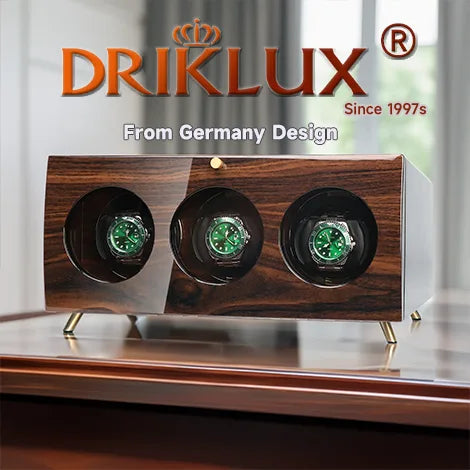
Expert recommendation: For $200-$500 mid-range, choose Driklux TPD watch winder—brushless stepper motor set custom TPD via DIP switches for Seiko Caliber 6R35 (720 TPD). Collectors like those on RolexForums advise modular upgrades: swap stepper drivers for lower current to cut heat by 20-30%.
You can find more information about how to choose a watch winder in our guide.
Consider a secure watch storage solutions for optimal results.
Common Challenges
Early watch winders, like budget models from the 1990s-2000s (e.g., basic Wolf or generic Chinese units under $50), relied on noisy AC induction motors with continuous humming from electromagnetic hum and gear meshing. These suffered from classic industrial motor failures adapted to 24/7 operation: overloading (16% of all motor failures), where constant rotor drag from heavy Rolex Submariners (e.g., Caliber 3135) or Omega Seamaster calibers caused excessive heat, melting insulation and emitting a burnt smell. Overheating struck first in stator windings during frequent starts—up to 6-8x rated current—exacerbated by poor ventilation in enclosed cabinets, leading to blackened windings and premature death after 1-2 years.
Shorted turns and ground faults were rampant from voltage spikes (e.g., cheap power adapters) or contaminants like dust in humid environments, shorting phase-to-phase and requiring full rewinds—impractical for $100 winders. Excessive vibration from loose windings or misaligned shafts rattled gears, wearing bearings and loosening Rolex Datejust bracelets inside. Voltage imbalance from unstable AC supplies caused uneven phase currents, overheating one winding while starving others.
Solutions for AC-era woes:
- Upgrade immediately: Ditch AC models; opt for inverter-duty rated if stuck, with VFD overload shutoff to prevent restarts on damaged units.
- Ventilate and monitor: Place in cool (<70°F), dry spots; use a $20 infrared thermometer on the motor housing—temps over 140°F signal overload; add silica packs against moisture.
- Match load to TPD: For power-hungry calibers like Rolex 3235 (60-hour reserve), select winders with 650-800 TPD at 4-8 RPM; avoid cranking 1000+ TPD on AC motors.
- Buying tip: Scan used Wolf Heritage singles ($80-150) for smooth hum only—no rattles; test with a multimeter for balanced voltage (110-120V steady).
Mid-2010s hybrids (e.g., Orbita Siena $400-600 or Everest Bands portables $200-350) shifted to DC motors and brushed steppers, quieter but prone to brush wear (carbon dust buildup after 10,000 hours), sparking shorts, and loose windings from vibration, causing erratic rotations that under-wind Daytonas (Caliber 4130). Degraded insulation from heat/moisture led to turn-to-turn shorts, especially in always-on setups. Bearing failures from misalignment (e.g., soft foot installation) amplified noise, fluting shafts via arcing. Harmonic distortion from PWM drives overheated windings, dropping efficiency.
Operational overloads hit when programming mismatches—like 720 TPD for a Seiko 6R35 (low torque)—drew excess amps, mimicking locked rotors. Single-phasing from blown fuses halted one phase, burning the rest.
Many collectors benefit from understanding watch winder selection tips.
Consider a watch winder security features for optimal results.
Buying Considerations
Watch winders originated in the mid-20th century to mimic human wrist motion for automatic calibers like Rolex's Caliber 3135 (used in the Submariner and Datejust) or Omega's Caliber 1120, which require 650-800 TPD (turns per day) bidirectional rotation. Early models from the 1980s-early 2000s relied on AC induction motors, common in household appliances and derived from industrial designs similar to those powering basic electric fans. These single-phase AC motors operate on 50/60Hz mains power, creating a rotating magnetic field via stator windings that induce current in a squirrel-cage rotor.
Key drawbacks: AC motors produce audible hums (40-60 dB at full speed) from electromagnetic vibration and rotor slip, risking disturbance in quiet environments like bedrooms. They lack precise speed control, often over- or under-winding delicate movements like the Patek Philippe Caliber 324, leading to premature mainspring fatigue. Efficiency hovers at 60-70%, with heat buildup (up to 50°C) potentially affecting lubricants in high-end calibers.
Brand examples and price ranges:
| Brand/Model | Motor Type | Price Range | Notes |
|---|---|---|---|
| Generic eBay/Amazon winders (e.g., "12-slot Chinese cubes") | Basic AC induction | $50-$150 | Noisy (50+ dB), plastic gears wear out in 1-2 years; avoid for Rolex Daytona Caliber 4130 (needs exact 720 TPD). |
| Driklux TPD watch winder | brushless stepper motor | $150-$2000 | Reliable for Seiko 5s, but hums during night cycles; directional switches fail after 18 months. |
What to avoid: Budget AC winders under $100 with exposed motors—no vibration dampening risks scratching cases on steel Submariners. Steer clear of unbranded AliExpress models; they draw high current (0.5-1A), spiking electricity bills and overheating.
By the late 2025s, manufacturers shifted to brushed DC motors (5V), adapting tech from power tools. These use a commutator and brushes to switch current in the rotor windings, enabling variable speed via PWM controllers for customizable TPD (e.g., 650 CW/CCW for TAG Heuer Carrera Caliber 5).
For detailed guidance, see our article on finding the perfect watch winder.
FAQs
What should I know about The Evolution of the Winder Motor?
Watch winders originated in the mid-20th century as collectors sought automated solutions to keep mechanical timepieces like the Rolex Submariner (Caliber 3135) or Omega Seamaster (Caliber 2500) wound without daily manual intervention. Early models, prevalent through the 1990s and into the early 2000s, relied on AC induction motors—simple, affordable electromagnetic devices powered directly from household outlets. These produced a persistent 60Hz hum from stator vibrations and ma
What are the most common mistakes to avoid?
Solutions for DC/brushed pitfalls:
- Lubricate bearings: Every 6 months, apply $10 Moebius 9010 synthetic to exposed shafts; realign feet with shims for zero vibration.
- Insulation checks: Use a $50 Megger tester for winding resistance (>1MΩ ideal); replace if corroded—common in humid garages.
- Overcurrent protection: Add a $15 DC fuse or smart controller; limit to 12-24V supplies.
- Buying tip: For Smith & Rowe Siena ($500+), verify brushed motors have jewel bearings; dema
What should I consider when buying?
What to avoid: Budget AC winders under $100 with exposed motors—no vibration dampening risks scratching cases on steel Submariners. Steer clear of unbranded AliExpress models; they draw high current (0.5-1A), spiking electricity bills and overheating.
Conclusion
Mastering the evolution of the winder motor: from noisy ac engines to silent brushless steppers ensures your luxury timepieces receive proper care. By investing in quality equipment and following best practices, you protect your investment for years to come.
Further Reading
For deeper understanding of the topics covered in this guide, explore these authoritative resources:
- Automatic Watch - Wikipedia — Wikipedia
Galería de productos