


Dealing With Radium And Tritium Dials In Enclosed Watch Winder Safes

Table of Contents
- Overview and Key Concepts
- Technical Specifications
- Expert Best Practices
- Common Challenges
- Buying Considerations
- FAQs
- Conclusion
For collectors, the key issue is not that radium or tritium dials make a closed winder safe “contaminated” in normal use; the real concern is condition, handling, and ventilation. Intact tritium watches are generally low-risk to store and wear, while radium watches deserve more caution because the main hazard is damaged lume, flaking dial material, and contaminated dust rather than the intact case itself.
You can find more information about choosing the right watch winder in our guide.
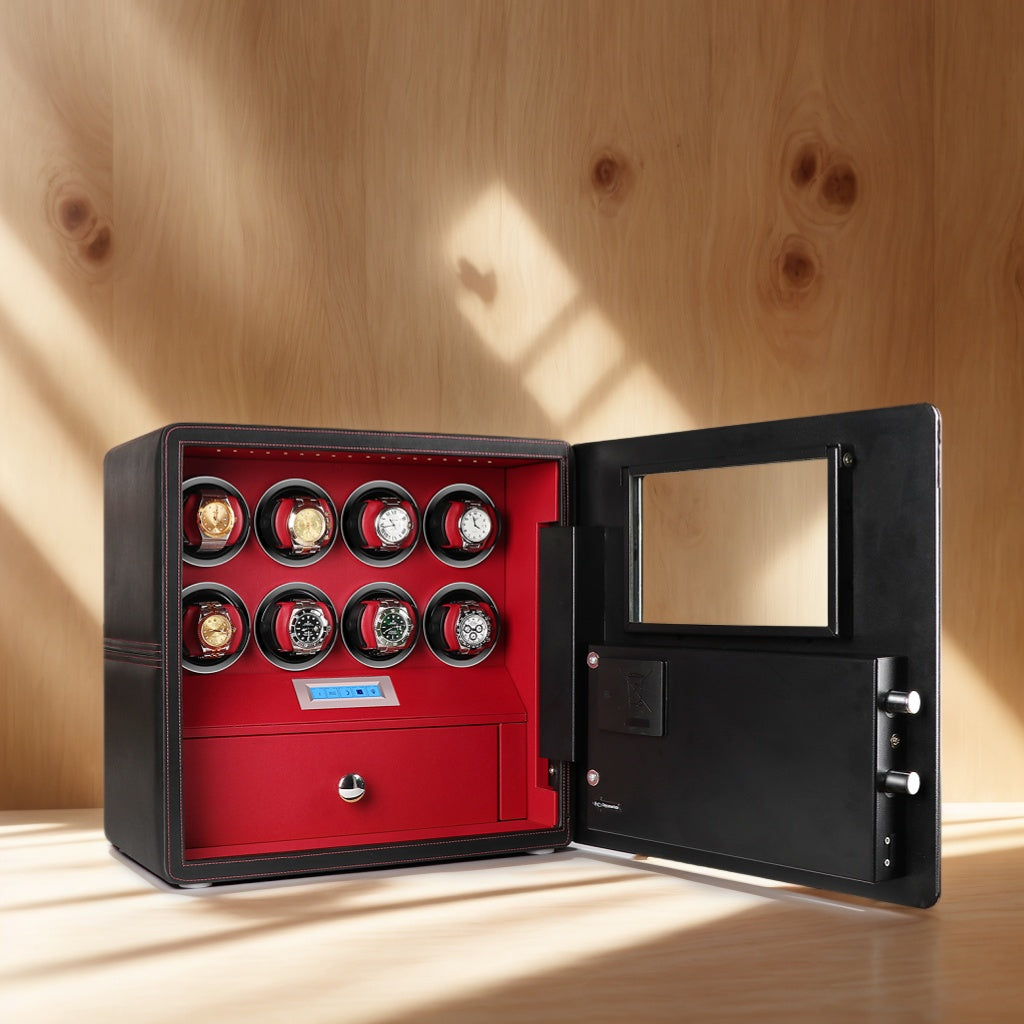
Overview and Key Concepts
For collectors, the key issue is not that radium or tritium dials make a closed winder safe “contaminated” in normal use; the real concern is condition, handling, and ventilation. Intact tritium watches are generally low-risk to store and wear, while radium watches deserve more caution because the main hazard is damaged lume, flaking dial material, and contaminated dust rather than the intact case itself.
- Radium dials are historically important but materially different from tritium. Radium emits alpha, beta, and small amounts of gamma radiation and is far more hazardous than tritium, which is a low-energy beta emitter with a 12.3-year half-life.
- A closed safe does not eliminate the need for good storage practice. Authorities note that intact watches enclosed in their cases pose relatively low risk, but radium watches can still emit radiation and may release radon in small quantities; if multiple vintage watches are stored together, periodic airing of the safe is recommended.
- Collectors preserve value by avoiding damage. Original radioactive lume can be part of a watch’s historical value, especially on vintage Rolex references such as the Submariner, Datejust, and Daytona, but aggressive reluming or amateur cleaning can destroy originality and collector appeal.
| Topic | Radium | Tritium |
|---|---|---|
| Typical era | Early/mid-20th century vintage pieces | Mid-century through late 1990s; modern tritium gas tubes still exist in some models |
| Radiation profile | Alpha, beta, and small gamma components | Low-energy beta emitter |
| Main risk | Inhalation/ingestion of degraded lume dust | Low exposure risk if intact; concern rises if the watch is damaged |
| Storage concern | Better kept separated, handled minimally, and checked for cracked crystals or flaking lume | Generally low risk in intact watches; still avoid unnecessary rough handling |
| Collector significance | Highly collectible on original military and early Rolex/Omega pieces | Collectible, but usually less hazardous and more recent |
-
Intact cases are the first line of defense. The dial and hands are enclosed by the watch case and crystal, and BfS notes that in normal use there is no contamination risk for people or objects nearby if the watch remains intact.
-
The risk changes if the crystal is cracked or missing. Vintage Gold Watches specifically warns that broken crystals or exposed lume increase the chance of inhaling or ingesting radium dust, which is the most serious hazard.
-
Ventilation matters more than “radiation-proofing.” For radium collections, opening the safe periodically helps disperse any radon that may accumulate when multiple pieces are stored together.
-
A winder is not the issue; the watch’s condition is. Brands such as Wolf, Orbita, Driklux, make storage and presentation products, but the safer setup for radioactive vintage dials is a well-organized safe with controlled access, soft watch pillows, and enough airflow to prevent stagnant storage conditions rather than a tightly packed, sealed compartment.
-
Buy the watch first for originality, not lume brightness. On a vintage Submariner or Datejust, original radium or tritium lume can be more valuable than a later service dial, but only if the dial is stable and honest to the watch’s era.
-
Inspect the crystal before purchase. A clean, intact crystal is crucial because it helps contain potentially friable lume dust; avoid examples with cracked crystals, missing hands, or visibly deteriorating plots unless you are buying them specifically as restoration projects.
-
Use professional servicing only. If a radium-dial watch needs work, use a watchmaker experienced with radioactive lume; do not scrape, brush, or relume it yourself.
-
Separate high-risk pieces from daily wearers. If your safe contains modern Rolex models such as a Caliber 3135 or 3235 watch alongside a vintage radium piece, store the radioactive watch in its own pouch or compartment so you do not spread dust during routine access. This is a practical collector workflow rather than a radiation requirement, but it reduces handling risk.
-
Prioritize humidity control and shock protection. A safe that protects from moisture and accidental knocks is useful because the bigger threat to lume integrity is deterioration, not the ambient radiation level.
Many collectors benefit from understanding selecting a quality watch winder.
A quality watch winder safe options makes a significant difference.
Technical Specifications
For an enclosed watch winder safe, the practical rule is straightforward: intact radium or tritium watches can usually be stored safely in a closed case, but you should treat radium dials as the higher-risk category and avoid any watch with a damaged crystal, flaking lume, or open caseback. Tritium models—especially modern GTLS tube watches—are generally safer in normal storage because the beta radiation is contained by the sealed glass tubes and the watch case.
- Radium dials: hazardous mainly if the lume is disturbed, powdered, inhaled, or ingested; intact watches pose much lower risk, but they still emit alpha, beta, and some gamma radiation.
- Tritium paint dials: lower hazard than radium, but the paint still contains radioactive material; the main risk is the same—disturbance of the dial or hands.
- Tritium tube dials: the tube system is considered safe under normal wear because the tritium gas is sealed in borosilicate microtubes and the watch case adds shielding.
If you’re writing for collectors, the most useful advice is to separate storage safety from service safety. A watch can be fine in a safe but still require special handling at service time.
Many collectors benefit from understanding watch winder buying guide.
A quality protecting your watch collection makes a significant difference.
Expert Best Practices
Radium and tritium watches can be stored in an enclosed watch winder safe, but the best practice is to treat them differently: radium needs more caution because the main risk is damaged lume dust and, to a lesser extent, radon accumulation in poorly ventilated enclosed storage, while tritium is generally safe when it is the modern sealed-tube GTLS type used by current brands.
For a collector using a safe or winder vault, the practical rule is simple: intact watches are low-risk; damaged lume is the problem. The German Federal Office for Radiation Protection states that when the dial and hands are enclosed and undamaged, contamination risk is low, and everyday wearing of such watches is typically far below (0.1 ,\mu\text{Sv}) per year in normal conditions. For radium pieces, multiple sources emphasize that the real hazard is inhalation or ingestion of paint dust if a crystal cracks or the lume flakes, especially during servicing.
- Keep radium watches intact and sealed. Do not open the case unnecessarily, do not clean or restore lume casually, and avoid any work that could release dust.
- Use ventilation in enclosed safes. If you store several vintage radium watches together in a closed safe or vault, open it periodically to disperse any radon that may off-gas from older radium paint.
- Add a radon monitor if the collection is large. Hodinkee’s discussion of the University of Northampton report notes that radium decays to radon gas and recommends ventilation awareness and a radon detector in the storage room.
- Avoid prolonged skin contact with suspect pieces. Holding or wearing an intact radium watch is usually low risk, but it should not be treated like a daily beater if the dial is deteriorating.
- If a crystal cracks, isolate the watch. Vintage Gold Watches recommends wrapping a broken radium watch in plastic, washing hands, and contacting a specialist with radium experience.
- Do not store damaged lume watches loosely with other pieces. Keep them in a separate compartment or container inside the safe so any debris is contained.
For tritium, the risk profile depends on the type of tritium system. Older tritium-painted dials were banned in many markets, while modern tritium watches usually use GTLS micro gas tubes under the crystal, which are sealed and considered safe in normal wear. NITE notes that beta radiation from sealed tubes cannot penetrate skin under normal use, and Ball Watch Company has said the tubes are well protected and that even if one breaks, the gas evaporates safely.
- Modern tritium tubes are safe in a winder safe. They are sealed and do not create the same dust hazard as deteriorating radium paint.
- Older tritium-painted dials deserve caution. Treat them more like radium-adjacent vintage lume because age-related flaking, not the isotope alone, is the issue.
- Mark suspect watches clearly. If you own a vintage Rolex with tritium lume, note references such as Submariner, Datejust, or Daytona so you can remember which pieces need special handling during service or storage; many vintage Rolex models used tritium-era dials before 1998.
You can find more information about how to choose a watch winder in our guide.
Professional collectors often choose secure watch storage solutions.
Common Challenges
When you keep radium or tritium watches in an enclosed watch winder safe, the main issues are not the rotor itself but poor ventilation, broken crystal/dial contamination, and unnecessary handling. Intact watches are generally low risk, but a safe that is rarely opened can trap any radon from radium decay and can also concentrate dust if a dial is deteriorating.
- Radium watch in a sealed safe: the biggest mistake is assuming “closed means safer.” Radium dials can give off radon gas, and a poorly ventilated storage space can allow buildup; one cited study reported much higher radon levels when 30 radium watches were kept in a poorly ventilated room.
- Tritium watch in a sealed safe: intact tritium lume is usually not the dangerous case; the sealed glass tubes used in modern tritium systems are described as safe in normal wear because beta radiation cannot penetrate skin and the tubes are hermetically sealed.
- Broken crystal or flaking lume: this is the real hazard with both radium and older tritium watches, because the risk comes from inhalation or ingestion of dust, not from simply storing the watch.
| Problem | What collectors get wrong | Why it matters | How to solve it |
|---|---|---|---|
| Sealed safe with no air exchange | Assuming an enclosed safe is “protective” for radioactive dials | Radium can produce radon, and poor ventilation can let it accumulate over time | Add passive ventilation to the storage room, crack the safe open periodically, and avoid stuffing many vintage radium pieces into a small, tightly sealed compartment |
| Storing multiple radium watches together | Treating a collection like ordinary jewelry storage | A single intact watch is usually low risk, but multiple pieces increase the total source material and radon potential | Keep radium pieces separated, store them in individual pouches or boxes, and reserve the safe for the most intact examples |
| Cracked crystal left in a winder | Leaving a visibly damaged watch running in the safe | A cracked crystal can release radioactive paint dust into the enclosure | Stop winding immediately, isolate the watch in a sealed bag/container, and send it to a specialist watchmaker familiar with radioactive dials |
| DIY dial cleaning or reluming | Treating vintage lume like normal restoration | Disturbing flaking lume increases the chance of inhaling dust | Do not open or abrade the dial yourself; use a watchmaker experienced with radium handling and containment procedures |
| No monitoring of storage environment | Relying on intuition instead of measurement | Radium risk is invisible; you may not notice radon or surface contamination | Use a Geiger counter to identify radioactive watches and consider a radon monitor in the storage room |
| Mixing vintage radioactive watches with daily-wear pieces | Treating all watches the same | Cross-contamination is unlikely with an intact watch, but damaged pieces can contaminate nearby items | Segregate vintage radium/tritium pieces from modern watches, especially in shared safes or watch cabinets |
| Assuming all luminous watches are equally risky | Lumping radium, tritium, and modern Super-LumiNova together | The risk profile differs substantially: radium is the main concern; intact tritium is much less concerning; modern lume is non-radioactive | Identify the lume type before storage and service; when in doubt, verify with a Geiger counter or a specialist |
-
Radium-dial pieces such as early Rolex Submariner, Datejust, and Daytona references with aged lume should be treated as fragile radioactive artifacts, not everyday safe queens.
-
If the watch is intact, keep it in a dry, ventilated storage area, not in a dead-air vault that is never opened.
-
If the watch is cracked, flaking, or missing its crystal, remove it from the winder safe and isolate it at once because the main danger is dust release.
-
For tritium sports watches and tool watches, the usual concern is age-related degradation, not normal radiation exposure; intact sealed tritium systems are described as safe in regular use.
-
If you are buying a pre-owned safe or winder system from brands like Wolf or Orbita, choose a setup that allows regular access and airflow rather than a completely stagnant storage box, especially if your collection includes 1940s–1960s military, dive, or aviation watches.
-
If you wear a vintage piece with radioactive lume, the risk is generally lower when the watch is intact, but sleeping with it, opening it unnecessarily, or servicing it yourself are the mistakes that create avoidable exposure.
-
Choose a safe with a modest internal air volume and a design that can be opened regularly rather than a completely sealed, forgotten vault.
-
Prefer individual watch holders so one compromised watch does not sit directly against the rest of the collection.
-
Add a radon detector if the safe is in a small room, closet, or basement storage area.
-
Keep a Geiger counter on hand if you buy vintage Rolex, Omega, Heuer, Tudor, military-issued watches, or unknown-service-dial pieces.
-
Budget for specialist servicing; a proper radioactive-dial assessment is cheaper than a botched relume or accidental contamination cleanup.
For detailed guidance, see our article on maintaining your automatic watch.
Consider a watch winder security features for optimal results.
Buying Considerations
If you are dealing with radium or tritium watches inside an enclosed watch winder safe, the safest approach is simple: keep the watch intact, minimize unnecessary handling, and choose a safe/winder system that prioritizes containment, ventilation, and low-vibration winding. For most collectors, the best buying path is a purpose-built watch safe from brands such as Brown Safe, Safe and Vault Store / JB, or a premium winder brand such as WOLF or Orbita, rather than a cheap generic box with an uncalibrated motor.
For a buying guide, the main distinction is this: radium dials deserve more caution than tritium dials because the real risk with radium is primarily from ingestion or inhalation of dust if the dial or crystal is damaged, while tritium is generally considered much lower risk because its beta particles cannot penetrate skin and are contained in sealed tubes or controlled watch-grade systems. In practice, that means a vintage Submariner, Datejust, or Daytona with radium lume should be treated as a collector display piece with controlled storage, whereas many tritium-era sports watches can be safely worn and stored with normal care if the case is intact.
What to look for in an enclosed watch winder safe
- Solid construction: reinforced steel or heavy-duty composite construction is preferred for watch safes.
- Reliable access control: digital keypad, biometric, or dual-lock systems are common in higher-end watch safes.
- Separated storage zones: keep radium or tritium pieces in a dedicated compartment rather than mixed loosely with daily-wear watches.
- Low-vibration winding modules: quality winding matters because poor motors can overwind or stress the movement.
- Correct settings for the caliber: automatic Rolex calibers such as 3135 and 3235 are common in pieces like the Submariner and Datejust, so make sure the winder offers flexible rotation programs rather than a one-size-fits-all cycle.
- Adequate spacing: avoid contact between watches, especially larger cases or bracelets that can rub against adjacent pieces.
Many collectors benefit from understanding watch winder selection tips.
FAQs
What should I know about Dealing with Radium and Tritium Dials in Enclosed Watch Winder Safes?
- Radium dials are historically important but materially different from tritium. Radium emits alpha, beta, and small amounts of gamma radiation and is far more hazardous than tritium, which is a low-energy beta emitter with a 12.3-year half-life.
- A closed safe does not eliminate the need for good storage practice. Authorities note that intact watches enclosed in their cases pose relatively low risk, but radium watches can still emit radiation and may release radon in small quantities; if multiple vintage watches are stored together, periodic airing of the safe is recommended.
What are the most common mistakes to avoid?
| Problem | What collectors get wrong | Why it matters | How to solve it |
|---|---|---|---|
| Sealed safe with no air exchange | Assuming an enclosed safe is “protective” for radioactive dials | Radium can produce radon, and poor ventilation can let it accumulate over time | Add passive ventilation to the storage room, crack the safe open periodically, and avoid stuffing many vintage radium pieces into a small, tightly sealed compartment |
| Storing multiple radium watches together | Treating a collection like ordinary jewelry storage | A single intact watch is usually low risk, but multiple pieces increase the total source material and radon potential | Keep radium pieces separated, store them in individual pouches or boxes, and reserve the safe for the most intact examples |
What should I consider when buying?
For a buying guide, the main distinction is this: radium dials deserve more caution than tritium dials because the real risk with radium is primarily from ingestion or inhalation of dust if the dial or crystal is damaged, while tritium is generally considered much lower risk because its beta particles cannot penetrate skin and are contained in sealed tubes or controlled watch-grade systems. In practice, that means a vintage Submariner, Datejust, or Daytona with radium lume should be treated as a collector display piece with controlled storage, whereas many tritium-era sports watches can be safely worn and stored with normal care if the case is intact.
Conclusion
Mastering dealing with radium and tritium dials in enclosed watch winder safes ensures your luxury timepieces receive proper care. By investing in quality equipment and following best practices, you protect your investment for years to come.
Further Reading
For deeper understanding of the topics covered in this guide, explore these authoritative resources:
- Recommended Reading: New Report Shows Radium Dials Might ... — Hodinkee
- Radioactive materials in watches - BfS — bfs.de
- A Brief History of Lume - Analog:Shift — analogshift.com
Galería de productos