


The Superstitions Of Winding: Why Some Collectors Only Trust Clockwise Rotations

Table of Contents
- Overview and Key Concepts
- Technical Specifications
- Expert Best Practices
- Common Challenges
- Buying Considerations
- FAQs
- Conclusion
Some collectors trust clockwise-only winding because they treat winding direction as a movement-specific discipline, not a universal preference. In practice, the right direction depends on the caliber, and the wrong setting usually means the watch simply won’t wind efficiently rather than being harmed.
For detailed guidance, see our article on optimal TPD settings for your watch.
Overview and Key Concepts
Some collectors trust clockwise-only winding because they treat winding direction as a movement-specific discipline, not a universal preference. In practice, the right direction depends on the caliber, and the wrong setting usually means the watch simply won’t wind efficiently rather than being harmed.
For a serious collector, the topic matters because a winder is not just convenience gear; it is a compatibility tool for protecting timekeeping consistency across a mixed collection. Modern automatic movements can be clockwise-only, counterclockwise-only, or bi-directional, so collectors who assume one direction fits all often end up with underwound watches, unnecessary resets, or avoidable frustration.
A useful way to frame the “clockwise superstition” is that it blends mechanical reality with collector habit. Some movements and winding systems respond best to a specific rotor direction, while many modern calibers wind in both directions thanks to reverser mechanisms; that is why premium winders commonly offer clockwise, counterclockwise, and both-direction modes.
- Direction is caliber-dependent. The correct setting depends on the movement architecture, not the brand name alone.
- Wrong direction usually doesn’t damage the watch. It generally fails to add meaningful wind, so the watch may stop if left on the wrong setting.
- Many modern automatics wind both ways. That includes a large share of contemporary luxury movements, which is why “both” is often the safest default for unknown or mixed collections.
- Some watches still prefer one direction. Vintage pieces and certain complication-driven calibers can be more particular about winding direction.
- TPD matters as much as direction. Turns per day, often in the 650–900 TPD range, determines whether the watch stays sufficiently wound; direction alone will not solve an underpowered setup.
Clockwise rotation has become a collector shorthand because many owners standardize around it when they are unsure, especially with watches that are known to respond well to clockwise winding. Guides to winding systems note that some movements are built to wind only in one direction, while others use bidirectional reversers to capture motion either way.
You can find more information about choosing the right watch winder in our guide.
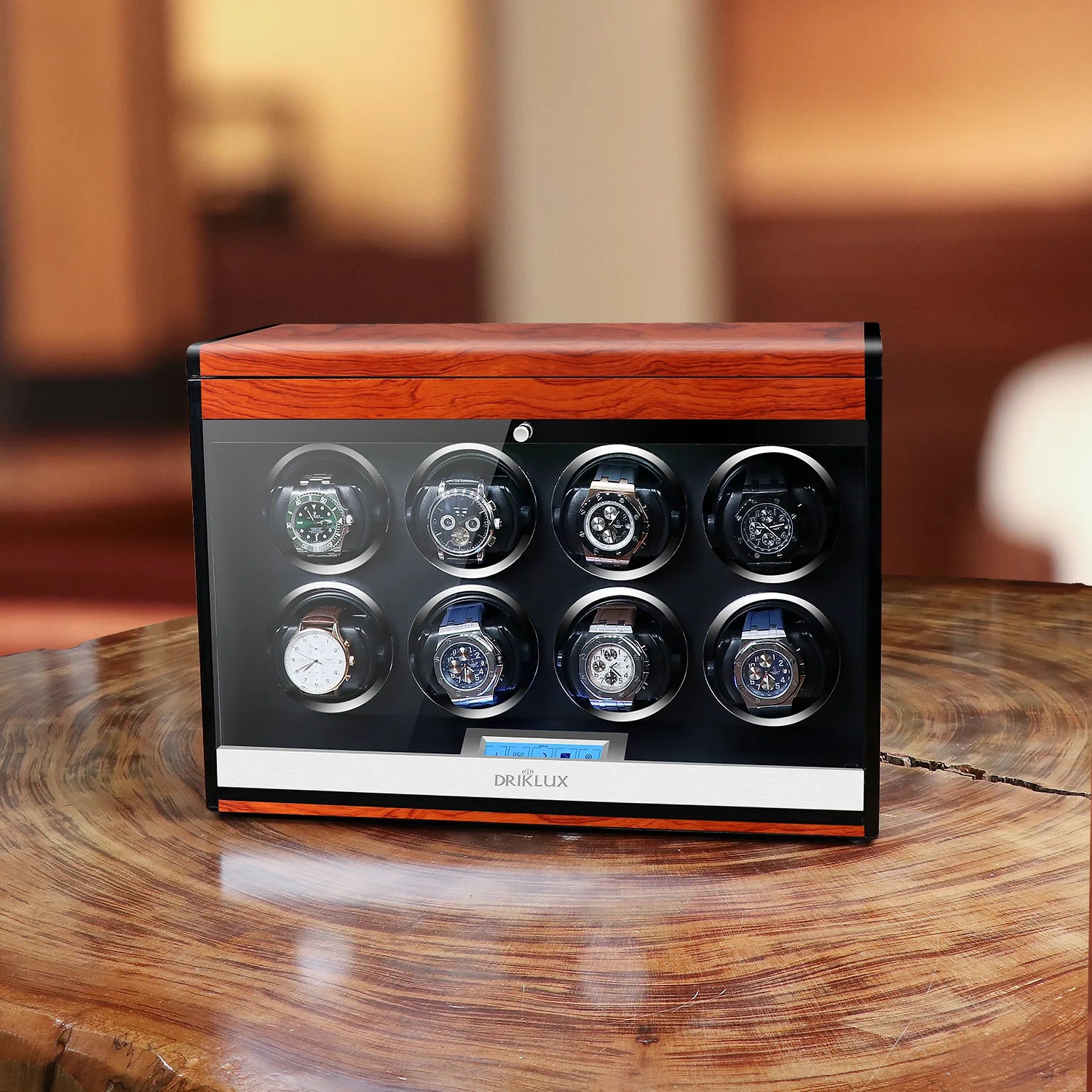
Professional collectors often choose watch winder with 6 winding capacity.
Technical Specifications
Some collectors prefer clockwise-only winding because many automatics were historically designed around one-direction rotor behavior, and because a winder set to the wrong direction can be less efficient—or, on some movements, effectively less useful. The key point is that direction preference is movement-specific, not a universal rule, so the right choice depends on the caliber inside the watch.
The historical reason the superstition persists is straightforward: early self-winding systems, including John Harwood’s 1923 patent, used a rotor/weight that wound in only one direction and traveled through a limited arc of about 130 degrees. Rolex’s early automatic development then introduced the Caliber 620, the first rotor system to make a full 360-degree rotation, but it still wound in only one direction. Modern automatics commonly use a reverser to wind in both directions, which is why many contemporary watches are compatible with bi-directional winders—but not all of them need it.
For collectors, the practical issue is matching the winder to the movement, especially with well-known Rolex calibers and models. For example, the Rolex Submariner has used calibers such as the 3135 and later the 3235; the Datejust likewise appears in many references powered by 3135/3235-family movements, while the Daytona historically used the Caliber 4030 and later the in-house 4130. Because these watches can be worn and wound differently depending on rotor architecture and clutch/reverser design, many owners prefer a winder that lets them choose clockwise, counterclockwise, or bi-directional settings rather than locking them into one mode.
A useful rule of thumb is that a good watch winder should offer multiple rotation modes and adjustable Turns Per Day (TPD). Barrington notes that many automatic watches can start from about 650 TPD, then be fine-tuned upward in steps such as 750 or 850 TPD if needed. This matters more than the superstition itself: if a watch is under-wound, it will stop; if it is continuously over-wound by excessive cycling, you are not “damaging” the mainspring in normal modern automatics, but you may be adding unnecessary wear to the rotor system and keeping the movement in constant motion. The real objective is stable power reserve and reliable timekeeping.
If you are buying a winder, the most important compatibility checks are these:
Many collectors benefit from understanding selecting a quality watch winder.
Consider a dual watch winder solutions for optimal results.
Expert Best Practices
Some collectors prefer clockwise-only winding because it feels safer, more controlled, and more intuitive—especially when they are handling vintage mechanical clocks or manually setting time on older movements. In practice, the real rule is simpler: follow the movement’s design, use the correct key, and stop at a firm resistance rather than forcing anything.
For clock collectors, the “clockwise superstition” is usually less about mechanics and more about habit and risk management. Many clocks wind clockwise, but some legitimately wind counterclockwise, and experienced repairers explicitly note that the direction depends on the movement. That means the best practice is not “always clockwise,” but “always correct for that specific clock”.
- Wind in the correct direction for that movement. Some clocks wind clockwise, others counterclockwise; forcing the wrong direction can damage the mechanism.
- Wind fully, but gently. Multiple repair sources say to continue until you feel a clear stop, then stop without forcing the key.
- Do not fear “overwinding” in the old myth sense. Several sources describe overwinding as a myth for healthy movements, while also warning that forcing a key against resistance can still cause damage over time.
- Set the time by moving the minute hand forward. Never move antique clock hands backward; turn the minute hand forward and let strikes/chimes complete naturally.
- Keep a regular routine. Eight-day clocks are typically wound weekly, while 30-hour clocks are wound daily; winding at the same time helps consistency.
The preference is partly psychological and partly practical:
- Consistency reduces mistakes. When a collector handles several clocks, a single “clockwise only unless verified otherwise” habit can reduce accidental forcing.
- Older clocks are less forgiving. Repair guidance repeatedly warns against reversing hands, forcing keys, or moving mechanisms out of sequence.
- Many collectors associate smooth clockwise rotation with controlled torque. That mindset is useful, even though the actual winding direction varies by movement.
You can find more information about watch winder buying guide in our guide.
Professional collectors often choose luxury 9 watch winder with added storage.
Common Challenges
Some collectors trust clockwise-only winding because it feels safer, more intuitive, and consistent with how most analog displays and many watch winders are marketed. In practice, the real rule is simpler: follow the movement’s design, because some clocks and mechanisms wind clockwise, some counterclockwise, and some accept only one direction while others tolerate both.
For a collector-focused piece, the key point is that the “clockwise superstition” is often less about physics than about risk avoidance: owners want to avoid stripping a crown, forcing a key, or stressing a mainspring near full wind. That caution is reasonable, especially with older or unserviced pieces, but it should be paired with correct technique and manufacturer guidance rather than a blanket rule.
-
Wrong winding direction
Some clocks wind clockwise, while others wind counterclockwise, depending on the movement. If a key does not turn smoothly in one direction, try the other direction gently; never force it.
Fix: Check the movement, or on a watch winder use the correct mode for the caliber rather than assuming clockwise-only operation. -
Forcing the key or crown
Forcing the key can damage the winding square, crown, or mainspring components. A tight fit matters: a loose or oversized key can round the edges of the winding square over time.
Fix: Use the correct-size key, insert it fully, and wind steadily until you feel a positive stop. -
Believing “overwinding” is the main danger
Multiple horology sources note that true “overwinding” is largely a myth for properly functioning clocks; apparent overwinding is often caused by a seized or dirty mainspring, not by turning too much.
Fix: Stop at the natural resistance point and service the movement if it binds, slips, or feels abnormal.
For detailed guidance, see our article on proper turns per day configuration.
Professional collectors often choose correct winding parameters.
Buying Considerations
Some collectors favor clockwise-only winding because many automatic movements are designed to wind efficiently in that direction, and a unidirectional winder can better match that behavior than a generic bi-directional setting. The practical buying question is not whether clockwise is “better” in the abstract, but whether it matches your watch’s movement, your rotation habits, and the quality of the winder’s programming.
For a complete buying guide, here is the most useful way to approach it:
- Best for clockwiseness-focused collectors: choose a winder with selectable direction and adjustable TPD (turns per day) so you can set clockwise-only for watches that prefer it, or switch to bi-directional for others.
- Best value range: basic single-watch winders commonly sit in the $50–$230 range in the market you mentioned; within that range, prioritize quiet motors, reliable direction control, and a stable watch cup over decorative features.
- Best for premium collections: higher-end multi-unit systems from brands such as Wolf and Orbita are typically chosen for better build quality, more refined programming, and quieter operation, making them more appropriate for Rolex, Omega, and other premium automatics.
- Best for accessory-first buyers: brands such as Everest Bands are better known for watch accessories than dedicated winders, so they are usually not the first stop if your main goal is precise rotation control.
- Best for budget-conscious buyers: brands such as Smith & Rowe can be attractive if they offer the basic features you need, but you should scrutinize motor noise, direction settings, and warranty support more carefully.
If you are shopping around specific Rolex references, the direction issue matters mostly because of movement behavior and how often the watch is worn, not because the model name itself demands “clockwise only.” For example, the Submariner, Datejust, and Daytona are all commonly paired with winders, but the correct setting depends on the installed caliber and the winder’s TPD/direction logic rather than the dial name alone.
You can find more information about TPD requirements for automatic watches in our guide.
FAQs
What should I know about The Superstitions of Winding?
- Direction is caliber-dependent. The correct setting depends on the movement architecture, not the brand name alone.
- Wrong direction usually doesn’t damage the watch. It generally fails to add meaningful wind, so the watch may stop if left on the wrong setting.
- Many modern automatics wind both ways. That includes a large share of contemporary luxury movements, which is why “both” is often the safest default for unknown or mixed collections.
- **Some watches still prefer one dire
What are the most common mistakes to avoid?
Some collectors trust clockwise-only winding because it feels safer, more intuitive, and consistent with how most analog displays and many watch winders are marketed. In practice, the real rule is simpler: follow the movement’s design, because some clocks and mechanisms wind clockwise, some counterclockwise, and some accept only one direction while others tolerate both.
What should I consider when buying?
- Best for clockwiseness-focused collectors: choose a winder with selectable direction and adjustable TPD (turns per day) so you can set clockwise-only for watches that prefer it, or switch to bi-directional for others.
- Best value range: basic single-watch winders commonly sit in the $50–$230 range in the market you mentioned; within that range, prioritize quiet motors, reliable direction control, and a stable watch cup over decorative features.
- **Best for premium collect
Conclusion
Mastering the superstitions of winding: why some collectors only trust clockwise rotations ensures your luxury timepieces receive proper care. By investing in quality equipment and following best practices, you protect your investment for years to come.
Further Reading
For deeper understanding of the topics covered in this guide, explore these authoritative resources:
- WatchTime — WatchTime Magazine
- OMEGA Official Site — Omega Official
Galería de productos