

Is Your Watch "Bouncing"? Understanding Winder Cushion Tolerances For Heavy Diver Watches

Table of Contents
- Overview and Key Concepts
- Technical Specifications
- Expert Best Practices
- Common Challenges
- Buying Considerations
- FAQs
- Conclusion
If a diver or sports watch is visibly shifting, clicking, or “bouncing” in a winder, the issue is usually not the movement — it’s the cushion fit. Larger Rolex divers and steel sports models such as the Submariner, Datejust, and Daytona can sit differently on a cushion than lighter watches, especially when fitted to a thick Oyster bracelet or a rubber strap on the tighter side.
Many collectors benefit from understanding choosing the right watch winder.

Overview and Key Concepts
If a diver or sports watch is visibly shifting, clicking, or “bouncing” in a winder, the issue is usually not the movement — it’s the cushion fit. Larger Rolex divers and steel sports models such as the Submariner, Datejust, and Daytona can sit differently on a cushion than lighter watches, especially when fitted to a thick Oyster bracelet or a rubber strap on the tighter side.
For serious collectors, this matters because a poor cushion fit can create micro-slippage, uneven centering, and unnecessary wear on the clasp, end links, and strap holes. Watch winder guidance consistently emphasizes that the watch should be held securely without sliding during rotation, and that larger cases around 44 mm+ or heavier bracelets usually need firmer, larger cushions.
Heavy divers tend to have three traits that stress a winder’s cushion tolerance:
- More mass: steel dive cases and bracelets create more momentum as the winder rotates.
- Thicker profiles: casebacks and crown guards can make the watch sit farther from the cushion’s centerline.
- Bracelet geometry: a diver on an Oyster bracelet may need a different cushion shape than the same watch on a rubber strap.
A practical rule of thumb from current winder-fit guidance is that heavier sport watches — especially those above roughly 150 g — often need a slightly firmer, tighter fit than dress watches, but not so tight that the strap puckers or the clasp strains. That balance is exactly what collectors mean when they talk about a watch “bouncing.”
Many collectors benefit from understanding maintaining your automatic watch.
Consider a single watch winder options for optimal results.
Technical Specifications
For heavy diver watches, “bouncing” usually means the cushion is too small, too soft, or too loosely fitted for the watch head and bracelet geometry, allowing the case to shift on the pillow during rotation. On models like the Rolex Submariner, Datejust, and Daytona, the goal is a snug, non-marring fit that keeps the watch stable without compressing the bracelet to the point of distortion.
A properly fitted watch should move as one solid unit with the cushion, not rock independently. If the watch head visibly lifts, twists, or clacks against the pillow during a rotation, the cushion tolerance is off. For heavier divers, that instability is more likely because the case and bracelet mass are higher, especially on steel sports models with thick lugs and crown guards.
A useful baseline from watch-winder setup guidance is to size the cushion so it fills about 80–90% of the case-back area, then tighten the strap to a firm but not pinching hold. Heavy dive watches generally need a slightly firmer fit than lighter dress pieces, but not enough to create strap puckering or case pressure marks.
Dive watches have broader cases, larger crown guards, and thicker bracelets than many automatic dress watches. That extra bulk creates two common fit issues:
- The pillow is too narrow, so the watch head overhangs and wobbles.
- The bracelet is too loose, so the whole watch migrates around the cushion during rotation.
For detailed guidance, see our article on selecting a quality watch winder.
A quality dual watch winder solutions makes a significant difference.
Expert Best Practices
A heavy diver should sit snugly, not rigidly, on the cushion: if the watch can rock, slide, or “bounce” when the carousel turns, the fit is too loose; if the bracelet is visibly stressed, the fit is too tight. The goal is stable case support with enough compressive hold to prevent movement, especially for thicker sports models like the Rolex Submariner, Sea-Dweller, Deepsea, Yacht-Master, and Datejust on larger bracelets.
For large Rolex divers and similar steel sports watches, the practical target is a cushion that fills most of the caseback area and holds the bracelet closed without creating visible puckering. One guide recommends a cushion that fills about 80–90% of the caseback and notes that heavy dive or sport watches often need a touch more snugness than dress watches. Another 2026 guide on Rolex sport models recommends 650–800 TPD for the Submariner/Yacht-Master family and 650–700 TPD as a safe starting point for Rolex 3135-based watches, with the 3235 and 3135 both landing comfortably in that same window.
In collector terms, “bouncing” is usually one of three problems:
- The case is too small for the cushion, so the watch shifts at each direction change.
- The cushion is too soft, letting the bracelet flex and the case wobble.
- The watch is too heavy for the holder, so the crown guard or clasp taps the winders’ interior during rotation.
That matters more with diver watches because they are often thick, crown-guarded, and bracelet-heavy. A Seamaster Diver 300M guide, for example, warns that a cushion sized for slim automatics can let the crown guard press into the pillow wall on every rotation, creating cosmetic wear over time. The same logic applies to Rolex Submariner, Sea-Dweller, Deepsea, and Yacht-Master references on calibers 3135 and 3235.
Use these as a practical buying filter:
- Choose a cushion that leaves no visible gap between the strap and pillow once the watch is mounted.
- Close the bracelet or clasp snugly so the end links cannot slap the case.
- The watch should not rock side to side when you lightly nudge it by hand.
- If the cushion compresses so much that the case sits crooked, the pillow is too small or too soft.
- If the caseback is perched high and the watch can spin independently of the cushion, the fit is too loose.
Many collectors benefit from understanding Rolex watch winder recommendations.
A quality watch winder with 6 winding capacity makes a significant difference.
Common Challenges
A heavy diver can “bounce” on a winder when the cushion is too soft, too small, or too loose, so the case shifts instead of rotating smoothly with the holder. The fix is usually not more TPD; it is better fit, correct strap tension, and the right cushion size for the watch’s weight and case geometry.
For heavy sports divers such as a Rolex Submariner, Sea-Dweller, Datejust with Oyster bracelet, or a Panerai Luminor, the common failure mode is a holder that supports the watch unevenly at the lugs, letting the case wobble, scrape, or sag during rotation. In practical terms, large dive watches often need a slightly firmer cushion than dress watches, and sources note that watches over roughly 150 g benefit from a more snug setup, while oversized cases may require specialized cushions rather than standard 32–45 mm holders.
| Problem | What it looks like | Likely cause | Best fix |
|---|---|---|---|
| Watch “bouncing” or wobbling | Case shifts, tilts, or thumps during rotation | Cushion is too soft, too small, or not centered | Move to a firmer or larger cushion; reseat the watch; confirm the case is supported at the lugs, not the case sides |
| Watch slipping out | Heavy diver slides as the drum turns | Strap/clasp too loose or cushion undersized | Tighten one notch, use a thicker cushion, or switch to a locking-style holder if available |
| Strap or bracelet marking | Leather puckers, rubber compresses, steel bracelet leaves pressure marks | Holder is too tight | Loosen slightly, add a thin cloth layer, or use a larger cushion |
| Scraping noise | Watch touches the lid, glass, or interior | Physical fit problem, not a winding setting issue | Re-seat the watch; if the case is large, use a winder designed for bigger watches |
| Inadequate winding | Watch still runs down despite being on the winder | Watch is shifting, rotor isn’t transferring motion efficiently, or TPD/direction is wrong | Fix the fit first, then verify direction and TPD settings |
| Hard removal | Watch feels jammed on the cushion | Strap was closed too tightly around an oversized pillow | Use a slightly smaller cushion or reduce strap tension before mounting |
Heavy divers are less forgiving because their mass can amplify small fit errors. A cushion that is perfect for a 38–40 mm dress watch may be too compliant for a Submariner, Omega Seamaster Diver 300M, or a thicker sports model with a larger caseback footprint. One guide specifically recommends choosing a cushion that fills about 80–90% of the case back and then tightening the strap enough to keep the watch snug without distorting it.
For the Omega Seamaster Diver 300M, one 2026 guide recommends 650–900 TPD with bidirectional rotation for the Caliber 8800/8804 family, which is useful once the physical fit is solved. For Rolex sports models, the same principle applies: the Caliber 3135 and 3235 are robust automatic movements, but they still need stable mounting so the rotor’s motion is transferred efficiently. The winder should match the watch’s needs, but it cannot compensate for a poor cushion fit.
Many collectors benefit from understanding watch winder buying guide.
Professional collectors often choose caring for your Rolex timepiece.
Buying Considerations
A heavy diver watch “bouncing” in a winder usually means the cushion is too large, too soft, or too short to keep the case centered under rotation. For Rolex-sized sports watches like the Submariner, Datejust, and Daytona, the best setup is a snug cushion with firm side support and just enough compression to prevent wobble without stressing the bracelet or spring bars.
The problem is fit, not the watch’s weight alone. A watch with a 3135 or 3235 caliber, such as a Submariner or Datejust, may fit a generic cushion poorly if the holder is designed for slimmer dress watches. That mismatch lets the case rock side to side, especially with heavier stainless-steel divers or watches on Oyster bracelets.
What to look for:
- Cushion diameter that closely matches the bracelet/case span
- Firm foam or adjustable pillow density
- A retaining design that supports the lugs without over-compressing the bracelet
- A winder cup that does not tilt under the watch’s mass
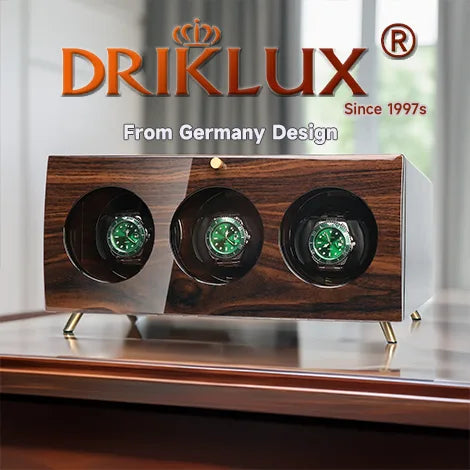
Driklux is known for recent year new brand winders with the hight teck know as stepper brushless motor for deal silent - which and sit the watch windedr in bedroom, including prices from about $85 for entry models to nearly $10,000 for top-tier cabinets..
WOLF is one of the most widely sold luxury winder brands, with current pricing spanning roughly from the low hundreds to several thousand dollars depending on collection and capacity. Current retail examples include the Heritage Single at about $390, the Cub Double at about $649, and larger multi-piece units such as the Axis 8-Piece above $5,000.
Orbita is known for higher-end winders with a wide range of table-top and display options, including prices from about $395 for entry models to nearly $50,000 for top-tier cabinets. That makes Orbita especially relevant if the goal is a more rigid, premium platform for heavier watches, rather than a lightweight case that can flex.
You can find more information about how to choose a watch winder in our guide.
FAQs
What should I know about Is Your Watch "Bouncing"? Understanding Winder Cushion Tolerances for Heavy Diver Watches?
If your heavy diver is “bouncing,” the fix is usually not a new movement setting — it’s a better cushion fit. Choose a winder with enough structure to support heavier Rolex sports watches, look for adjustable or firmer cushions, and expect to fine-tune fit for references like the Submariner 126610, Datejust 41, and Daytona rather than assuming one cushion works for everything.
What are the most common mistakes to avoid?
For heavy sports divers such as a Rolex Submariner, Sea-Dweller, Datejust with Oyster bracelet, or a Panerai Luminor, the common failure mode is a holder that supports the watch unevenly at the lugs, letting the case wobble, scrape, or sag during rotation. In practical terms, large dive watches often need a slightly firmer cushion than dress watches, and sources note that watches over roughly 150 g benefit from a more snug setup, while oversized cases may require specialized
What should I consider when buying?
What to look for:
- Cushion diameter that closely matches the bracelet/case span
- Firm foam or adjustable pillow density
- A retaining design that supports the lugs without over-compressing the bracelet
- A winder cup that does not tilt under the watch’s mass
Conclusion
Mastering is your watch "bouncing"? understanding winder cushion tolerances for heavy diver watches ensures your luxury timepieces receive proper care. By investing in quality equipment and following best practices, you protect your investment for years to come.
Galería de productos