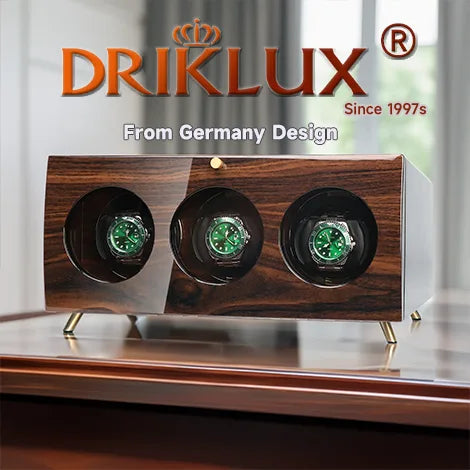


The Decibel Test: Comparing Driklux Brushless Motors To City Background Noise

Table of Contents
- Overview and Key Concepts
- Technical Specifications
- Expert Best Practices
- Common Challenges
- Buying Considerations
- FAQs
- Conclusion
For serious collectors, the decibel profile of a watch winder matters because noise is not just a comfort issue—it is a proxy for motor quality, vibration control, and bedroom-friendly usability. Driklux’s brushless/stepper approach is positioned for sub-10 dB operation, which is dramatically quieter than budget brushed winders in the 30–40 dB range and quieter than ordinary city backgro
For detailed guidance, see our article on choosing the right watch winder.

Overview and Key Concepts
For serious collectors, the decibel profile of a watch winder matters because noise is not just a comfort issue—it is a proxy for motor quality, vibration control, and bedroom-friendly usability. Driklux’s brushless/stepper approach is positioned for sub-10 dB operation, which is dramatically quieter than budget brushed winders in the 30–40 dB range and quieter than ordinary city background noise in many common indoor settings.
The key point is that collectors are not only buying rotation; they are buying stability, silence, and long-term reliability. Brushless motors eliminate the brush-and-commutator friction that makes brushed motors mechanically noisier, and quieter designs are generally associated with lower vibration and less audible “whine,” which matters when a winder sits on a nightstand, in a dressing room, or inside a safe.
- Acoustic comfort: A watch winder that sounds “busy” can be distracting in a quiet bedroom, office, or display room.
- Mechanical gentleness: Lower noise often correlates with smoother drive behavior and less vibration, which is important for watches such as the Rolex Submariner, Datejust, and Daytona—especially when collectors rotate pieces frequently rather than storing them passively.
- Brand and build differentiation: Premium winder makers such as Driklux, Wolf, Orbita, Everest Bands, and Smith & Rowe compete not just on aesthetics, but on how quietly and consistently their motors operate across multi-watch setups.
- Nightstand test: Driklux specifically frames the practical threshold around overnight use, noting that noise above 40 dB becomes disruptive for bedside placement.
A useful way to think about the issue is by comparing the winder to familiar environmental sounds:
- Under 10 dB: Driklux’s claimed operating zone for quality stepper/brushless designs is effectively near-silent in real-world use.
- 30–40 dB: Typical budget brushed winders; this is quiet in absolute terms, but still clearly audible in a silent room.
- 40 dB and above: Driklux identifies this as disruptive for bedside use, which is why many collectors reject “cheap but audible” units.
Many collectors benefit from understanding selecting a quality watch winder.
A quality single watch winder options makes a significant difference.
Technical Specifications
Driklux’s brushless motors are positioned as a low-noise, low-vibration solution, and the brand’s own messaging claims <15 dB operation, which is quieter than typical office ambience and well below most city background sound levels. More broadly, brushless DC motors are favored in precision applications because they offer reduced energy use, long life, low noise, compact size, and light weight.
For a technical comparison in a watch-winder context, the key point is not just raw noise output but how the motor’s torque, reduction ratio, and control logic affect the watch’s motion profile. Driklux states that its winding systems use Bluetooth app control, remote monitoring of status, TPD, and rotation, and individual slot programming, which matters when matching winding behavior to specific calibers like the Rolex Caliber 3135 or 3235 and to watch families such as the Submariner, Datejust, and Daytona. In practical terms, that means the winder can be tuned for different winding requirements rather than applying a one-size-fits-all cycle.
If you are comparing a winder’s motor specification directly, one useful benchmark from industrial brushless motor documentation is a 24V BLDC platform with 50W output power and a 5:1 to 100:1 reduction ratio. That kind of specification matters because reduction gearing can lower effective rotational speed and smooth out motion, helping reduce audible vibration and mechanical stress on the watch.
Driklux’s earlier technical discussion also notes that older, higher-inertia winding approaches could create 0.05–0.1 Nm peak torque demands that increased vibration and stressed delicate escapements in ETA calibers. The implication for premium watches is straightforward: a quieter motor is valuable, but controlled torque delivery is equally important for preserving the movement’s long-term health.
For buyers comparing premium brands, the market context is useful:
- Driklux emphasizes sub-15 dB operation and app-based programming.
- Wolf is widely known for luxury watch winders, typically priced in the premium segment rather than the budget range.
- Orbita is another established name in the high-end winder space, often selected by collectors for robust, movement-specific programming.
- Everest Bands and Smith & Rowe are more often encountered in the wider luxury-accessory ecosystem, with pricing and feature sets varying substantially by model and retailer.
For detailed guidance, see our article on watch winder buying guide.
A quality dual watch winder solutions makes a significant difference.
Expert Best Practices
For a premium watch winder, the real benchmark is not just “brushless” on the spec sheet, but whether the unit stays effectively inaudible at bedside distance. Driklux’s own guidance says quality stepper or brushless designs can operate below 10 dB, while budget brushed winders often sit around 30–40 dB; for context, Driklux also notes that anything over 40 dB is disruptive for bedside use.
When you compare that to city background noise, the difference is substantial. A quiet bedroom at night is often closer to a calm indoor environment than to a street scene, while a typical urban background—traffic, HVAC, distant voices—generally sits far above the sub-10 dB range described for premium winders, so a well-tuned Driklux motor should disappear into the room rather than compete with it. In practical collector terms: if you can hear the winding cycle from your pillow, the motor is not really “silent” in the horological sense.
- Set your benchmark correctly: Use a phone decibel app only as a rough screen, not a lab instrument. Measure at the exact sleeping position, because a winder that reads quietly at the desk can sound louder next to a nightstand.
- Prioritize sound quality, not just sound level: A faint tonal whine is more noticeable than a slightly higher broadband hum. Acoustic comparisons in motor engineering consistently show that perceived annoyance depends on frequency content, not only decibels.
- Look for stepper or brushless drive with refined control: Driklux’s engineering-focused material emphasizes quiet operation and durability as the reason for choosing stepper brushless motors, and its guide specifically frames these as the preferred drive for watch winders.
- Avoid bargain brushed motors for bedroom use: Budget winders in the $50–$230 bracket are where you most often encounter more audible motor noise, especially at the lower end of the range, while premium units typically justify their price through better bearings, improved control logic, and reduced vibration.
- Test overnight, not just in a showroom: Driklux recommends an overnight noise test; that matters because intermittent ticking, gearing noise, or resonance can become far more noticeable after the room goes quiet.
- Compare real-world use, not marketing claims: A winder for a Rolex Submariner with Caliber 3235, a Datejust with Caliber 3135/3235, or a Daytona with a different winding profile should be judged by how smoothly the winder handles your specific rotation program, not by generic “ultra-quiet” language. Different calibers and rotor behavior make vibration control as important as motor type.
- Check vibration isolation: Even an almost silent motor can transmit cabinet resonance into wood furniture or glass shelves. Soft feet, balanced rotor mounts, and well-fitted internal bushings matter.
- Match the winder to the watch collection, not vice versa: If you rotate multiple pieces from brands like Wolf, Orbita, Everest Bands, or Smith & Rowe, look for independently controlled modules and programmable turns-per-day so the machine doesn’t overwork the watch just to sound impressive.
- Favor conservative winding schedules: For modern automatic movements, more winding is not automatically better. Properly programmed cycles reduce unnecessary running time, which lowers cumulative noise and wear.
- Demand measurable claims: If a brand says “near silent,” ask for the measurement distance and conditions. A meaningful spec should state the reference point, because 10 dB at 1 meter and 10 dB at the cabinet face are not the same thing.
- Buy for the room, not the spec sheet: A winder that is inaudible in a study may still be too lively on a hollow nightstand. Solid furniture, wall proximity, and room acoustics change the result more than most shoppers expect.
Experienced collectors usually choose in this order: motor smoothness first, vibration control second, programming flexibility third, and style last. That order is especially sensible if the winder will sit beside a daily rotation piece like a Submariner or Datejust, where low mechanical disturbance matters more than flashy lighting or display gimmicks.
If you want a practical buying rule: for bedroom placement, choose a unit that is explicitly engineered to stay below 10 dB, has a documented stepper or brushless drive, and is housed in a rigid enclosure with proper damping. For a living room or office, a slightly louder unit may be acceptable—but for bedside use, anything that audibly competes with the room’s own background noise is not collector-grade quiet.
You can find more information about how to choose a watch winder in our guide.
Consider a triple watch roll travel case secure storage for optimal results.
Common Challenges
The main problems with brushless watch winder noise claims are usually not the motor itself, but how the sound is measured, what other parts are vibrating, and what the listener is comparing it against. For a Driklux-style “decibel test,” the biggest challenge is that city background noise often masks very small differences, so the real question is whether the winder stays below the threshold where it becomes noticeable in a bedroom or office.
For a blog section on “common problems, mistakes, and challenges — and how to solve each one,” here is a collector-focused breakdown:
| Problem | Why it happens | How to solve it |
|---|---|---|
| Measuring the wrong thing | A single dB number can hide differences in tone, pitch, and vibration; brushless designs are often quieter in practice, but sound quality matters as much as volume | Measure at a fixed distance, same room, same surface, and note whether the sound is a low hum or a high-pitched whine |
| Comparing against the wrong baseline | People compare a winder to “silent,” but real homes already have HVAC, traffic, and appliance noise; city centers commonly sit in the high-60s dB range | Compare the winder to ambient bedroom noise and city background noise, not to an anechoic ideal |
| Assuming brushless means inaudible | Brushless motors remove brush friction, but noise can still come from gearing, bearings, pulse-width modulation, or enclosure resonance | Check the drivetrain, bearing quality, controller frequency, and cabinet isolation, not just the motor spec |
| Overlooking vibration transfer | A quiet motor can still transmit vibration into a desk, shelf, or nightstand, making the unit seem louder than it is | Use soft feet, a rigid but isolated shelf, and avoid hollow furniture that acts like a soundboard |
| Ignoring load effects | Noise can rise when the unit is carrying heavier watches or running inefficiently under higher load | Test with your actual watches, including heavier sports models like a Rolex Submariner, Datejust, or Daytona, rather than an empty rotor |
| Misreading decibel differences | A 2–4 dB difference may be measurable but not dramatic in daily use; larger differences matter more when they change the sound character | Focus on whether the unit disappears into ambient noise at night, not only on the meter reading |
| Testing at the wrong speed setting | Some motors are quiet at low speed but become more noticeable at mid-range or full-speed settings | Evaluate the exact TPD and rotation program you will actually use for calibers like 3135 or 3235 |
| Buying on brand reputation alone | Premium names do not guarantee low acoustic output; construction quality still varies by model and controller design | Compare Driklux, Wolf, Orbita, Everest Bands, and Smith & Rowe by measured noise, not prestige alone |
A practical takeaway for readers is that brushless motors are usually quieter than brushed designs because they eliminate brush friction, but the final result depends on the whole system: controller, bearings, gearing, enclosure, and mounting surface. That is why two winders from different brands can feel very different even if both are marketed as “silent.”
For the city background noise comparison, the most useful framing is this: if urban ambient noise often sits around the mid-60s to high-60s dB range, then a well-designed winder that stays well below that level will usually blend into the room rather than compete with it. In practice, that means a properly engineered brushless unit should be judged less like a power tool and more like a bedroom appliance.
Many collectors benefit from understanding watch winder selection tips.
Professional collectors often choose quality single watch winders.
Buying Considerations
A brushless watch winder motor should be judged less by a single decibel number and more by whether its sound stays below the point where it blends into ambient room noise. In practical terms, a winder in the low- to mid-50s dB range will usually be audible in a quiet room, while a unit closer to typical city background noise can be masked more easily by HVAC, traffic, or conversation; normal conversation is around 60 dB, passing cars are often around 73 dB, and a luxury-car cabin at speed is commonly 60–70 dB.
For a buying guide, the safest approach is to compare motor type, sound character, build quality, warranty, and channel reliability rather than trusting “silent” marketing language. Brushless designs generally reduce friction and wear versus brushed motors, and one engineering comparison notes that brushless units can deliver a 6–10 dB(A) reduction versus brushed designs in similar products.
- 50 dB: quiet enough that many users will notice it in a silent bedroom, but it may disappear in a typical living space.
- 60 dB: roughly normal conversation level; audible, but not intrusive in many homes.
- 65 dB and above: in city terms, this is where sound becomes clearly noticeable and can start to feel irritating in a quiet room.
- A reduction of 10 dB is commonly perceived as about half as loud by human listeners, so even a modest reduction matters in real use.
For watch winders, that means the goal is not just “quiet,” but non-fatiguing sound: no high-pitched whine, no rhythmic clicking, and no motor surging during direction changes.
| Brand | Typical positioning | What to look for | Main cautions |
|---|---|---|---|
| Driklux | Premium-value brushless focus | Low-noise motor behavior, consistent rotation, good case finish | Verify actual dB claims and return policy |
| Wolf | Established luxury brand | Strong presentation, polished interiors, broad product range | Often priced above functionally similar alternatives |
| Orbita | Specialty watch-storage brand | Reputation in collector circles, engineered rotation systems | Higher cost; check fit for larger watches |
You can find more information about finding the perfect watch winder in our guide.
FAQs
What should I know about The Decibel Test?
- Constant hum vs. mechanical chatter: Brushless/stepper systems should avoid the rasping texture associated with brushed motors.
- High-frequency whine: This is often more annoying than a low hum and is a common complaint with less refined systems.
- Vibration transfer: A winder that transmits vibration into furniture can seem louder than its measured decibel level suggests.
- Load consistency: A good unit should remain steady whether it is turning one watch or several, without
What are the most common mistakes to avoid?
For a blog section on “common problems, mistakes, and challenges — and how to solve each one,” here is a collector-focused breakdown:
What should I consider when buying?
For example, sport models such as the Rolex Submariner and Rolex Daytona can be heavier and more demanding than a Datejust, so a weak or inconsistent motor may sound worse when turning those cases repeatedly. On the movement side, watches using calibers like the 3135 and 3235 are common collector references, but the correct winder setting should still be based on the watchmaker’s recommendation rather than the caliber number alone.
Conclusion
Mastering the decibel test: comparing driklux brushless motors to city background noise ensures your luxury timepieces receive proper care. By investing in quality equipment and following best practices, you protect your investment for years to come.
Further Reading
For deeper understanding of the topics covered in this guide, explore these authoritative resources:
- Hodinkee /Driklux Brushless Motor — Hodinkee
- Monochrome Watches — Monochrome Watches
Galerie de produits