


Setting Watch Winders For Power Reserve Indicators That "Jump"

Table of Contents
- Overview and Key Concepts
- Technical Specifications
- Expert Best Practices
- Common Challenges
- Buying Considerations
- FAQs
- Conclusion
Power reserve indicators that “jump” are usually not a defect in the watch itself; they are a clue that the watch’s winding system, reserve display geometry, or winder settings may not be matching the movement’s needs. For collectors, the issue matters because the wrong winder setup can create misleading readings, incomplete winding, or unnecessary wear on a movement that should otherwise be s
Many collectors benefit from understanding choosing the right watch winder.
Overview and Key Concepts
Power reserve indicators that “jump” are usually not a defect in the watch itself; they are a clue that the watch’s winding system, reserve display geometry, or winder settings may not be matching the movement’s needs. For collectors, the issue matters because the wrong winder setup can create misleading readings, incomplete winding, or unnecessary wear on a movement that should otherwise be stable and predictable.
Collectors care about this topic because a power-reserve display is not just decorative—it is a direct status readout of mainspring energy, and brands use it to tell you when the watch is approaching the end of its usable reserve. A. Lange & Söhne’s Datograph Up/Down, for example, explicitly uses the “UP/DOWN” indicator to show how much of its 60-hour reserve remains, and the watch should be wound once the hand enters the red zone. Seiko’s instructions likewise treat the display as a practical guide for when to wind the watch and note that the indicator can move beyond the zero mark on some models without indicating a fault.
The “jumping” behavior collectors notice usually falls into a few categories:
- Normal stepped display behavior. Some reserve indicators do not move in a perfectly smooth sweep; they can advance in small increments because of the way the gearing transfers barrel tension to the dial display.
- Rotor-dependent lag. If the movement is being wound intermittently, the display may appear to lag or jump rather than glide, especially when the watch is only lightly active on a winder or on the wrist.
- Calibration mismatch. Some watches show “full” on the indicator before the mainspring is truly at maximum tension, so the display can appear to jump or plateau while the barrel still has additional wind available.
- Potential mechanical issue. If the hand sits off-scale, hesitates abnormally, or barely responds to winding, the winding train, indicator linkage, or display hand may need professional inspection.
For serious collectors, the key point is that a watch winder is not meant to “force” a reserve indicator into a perfect visual pattern. It is meant to keep the movement within a healthy operating state. Seiko’s manuals emphasize manual winding when needed and make clear that a fully wound state is the goal, not continuous over-rotation. Longines similarly notes that some watches can be wound by rotating the crown in the correct position, but the exact crown behavior varies by model.
For detailed guidance, see our article on maintaining your automatic watch.
Professional collectors often choose single watch winder options.
Technical Specifications
A jumping power-reserve indicator is one that moves in discrete steps rather than sweeping smoothly, and on a watch winder the key is to set enough daily winding to keep the reserve out of the “low” zone without over-spinning the watch. For most automatic watches, that means choosing the correct TPD (turns per day) and rotation direction for the specific caliber, then verifying the indicator’s behavior after a full wind and a controlled run-down.
For collectors and retailers, the practical rule is: if the indicator “jumps” in larger increments, you should judge the watch by range rather than by tiny hand movement, and use the winder to keep the indicator in the upper working band, not necessarily pinned at full. Seiko’s own manuals describe the indicator as a state-of-charge display that moves toward the full mark when wound and toward the zero mark as the mainspring unwinds.
- Start with the movement, not the brand name. Many movements wind differently, and the same brand can use several calibers with different winding behavior and reserve capacity.
- Set a moderate TPD first. If you do not have the exact caliber data, begin with a middle setting and check whether the watch stays above the lower third of the reserve scale after 24 hours off the winder.
- Match rotation direction. Some calibers wind in one direction, others in both; bi-directional is the safest default when the movement’s winding direction is unknown.
- Use the reserve indicator as a diagnostic tool. A healthy watch should show the indicator rising during winding and falling predictably afterward; erratic jumps, lag, or no movement can indicate a winding-system issue rather than a winder problem.
| Movement / caliber | Power reserve | Indicator behavior | Practical winder note |
|---|---|---|---|
| Rolex 3135 | about 48 hours | No dial power-reserve display on standard Submariner/Datejust examples; reserve must be inferred from running time | Use the winder to maintain running state, but rely on TPD tuning rather than an indicator reading |
| Rolex 3235 | about 70 hours | Same as above on most references; no standard dial reserve display | Longer reserve means you can use a lower-maintenance winder setting than older 31xx calibers |
| Seiko 4R57 | display shows near 40/F as fully wound | Indicator moves from full toward 0/E as it unwinds | Useful benchmark for watches with obvious “jumping” reserve windows |
| Seiko 6R64 | display shows near 45/F as fully wound | Indicator moves toward 0/E as it unwinds | Good example of a stepped reserve scale that is easy to read on a winder |
| Seiko 6R20 / 6R21 / 6R24 / 6R27 | display shows near 45/F as fully wound | Indicator decreases toward 0/E | Treat the winder as a maintenance tool, not a way to force the hand to “look full” |
- Rolex Submariner: on calibers such as 3135 or newer 3235, there is no visible power-reserve hand, so the winder should be set by performance and carry time rather than by a dial indicator.
- Rolex Datejust: same logic as the Submariner; the watch’s reserve is internal, so the winder goal is simply to keep it ready to wear.
- Rolex Daytona: many modern Daytonas use different calibers than the Submariner/Datejust family, so do not copy settings across references without checking the movement first.
- A. Lange & Söhne Datograph Up/Down: the UP/DOWN display explicitly shows remaining reserve, with the hand reaching the red zone when it is time to wind again.
- Seiko power-reserve models: these are ideal for testing winder settings because the reserve hand gives immediate feedback on whether the watch is being kept in a healthy charge band.
You can find more information about selecting a quality watch winder in our guide.
A quality dual watch winder solutions makes a significant difference.
Expert Best Practices
When a power reserve indicator “jumps” instead of moving smoothly, the most useful approach is to treat it as a readout to calibrate against the movement’s actual runtime, not as a perfect fuel gauge. In practice, collectors get the best results by fully winding the watch by hand, running a timed discharge test, and then setting the winder so it maintains a healthy mid-to-high reserve rather than constantly chasing 100%.
For a blog section aimed at experienced collectors, the key point is this: a jumping indicator is usually normal behavior of the complication, but it can also reveal that the watch is under-wound, being wound too aggressively by the winder, or not matching the winder’s TPD/direction profile.
- Start with a full manual wind, not the winder first. The best calibration method is to fully wind the mainspring until it reaches its mechanical stop or firm resistance, then let the watch run down while watching how the indicator drops over time.
- Use the indicator as a benchmark, not a target. Seiko’s guidance for movements with a power reserve display is to check the indicator before removing the watch and wind if needed so it has enough stored energy to keep running until next wear.
- If the hand “jumps,” compare it to published reserve, not the dial graphics. Some reserve hands move in discrete steps because the underlying gear train advances in increments rather than continuously; what matters is whether the watch reaches its rated reserve after a full wind.
- Watch for mismatch between the indicator and the real reserve. If the display reads low earlier than expected, or the hand hops irregularly, that is a cue to test the watch off-wrist and document the behavior for a technician.
- Keep a log. A simple note of the starting reserve, hours on the winder, and the time until stop is the fastest way to dial in settings for future use.
For setting the winder itself, collectors generally get the best results by matching the movement’s winding needs rather than using a generic “high TPD” setting.
- Typical modern winder settings often fall in the 500–800 TPD range, but that is only a broad baseline and should not replace the movement’s own requirements.
- Use rotation direction correctly. The wrong direction can produce poor winding efficiency even when the winder is running normally.
- Prefer cyclic winding, not constant rotation. A common modern pattern is 4–6 minutes of rotation followed by 8–12 minutes of rest, repeated through the day.
- Aim for about 70–90% reserve, not perpetual full wind. Many enthusiasts find that this keeps the watch ready without needlessly stressing the crown workflow or masking an underlying calibration issue.
You can find more information about watch winder buying guide in our guide.
Consider a compact classic triple watch winders for optimal results.
Common Challenges
A power-reserve indicator that jumps is usually telling you one of two things: the watch is not being wound in a smooth, repeatable way, or the indicator mechanism itself is seeing friction, slack, or misalignment. In practice, the fix is often as simple as correcting the TPD, rotation direction, or fit on the cushion—but a genuinely erratic reserve hand can also point to a movement issue that needs a watchmaker.
For collector-grade automatics, it helps to think of the power-reserve display as a diagnostic tool, not just a convenience feature. If the hand lags, hesitates, or “snaps” suddenly, the causes usually fall into three buckets: winder setup, watch state, or movement condition.
| Problem | What it looks like | Likely cause | Practical fix |
|---|---|---|---|
| Reserve hand jumps after mounting on a winder | The indicator moves in bursts instead of a steady decline or gradual refill | The watch is not seated squarely, the rotor is not coupling cleanly, or the winder is set too aggressively or too weakly | Re-seat the watch, confirm snug fit, and adjust TPD in small increments; test again for 8–12 hours. |
| Watch stops despite being on the winder | Power reserve remains low or the watch dies overnight | TPD is too low, rotation direction is wrong, or the watch started from a nearly empty mainspring | Manually wind first, verify the manufacturer’s winding spec, then raise TPD gradually if needed. |
| Indicator “snaps” near full or empty reserve | The hand seems to jump at one point on the scale | Slack or wear in the linkage, a slipping pinion, or a fatigued spring in the indicator mechanism | If repeatable after correct winding, have the movement inspected; this is not usually a winder problem. |
| Reserve display reads full but the watch stops early | The watch appears wound, then dies well before expected reserve | The mainspring may not have been fully charged, or the watch has a service issue | Fully wind, let it run down, and compare actual reserve to spec; if short, service is likely needed. |
| Seconds hand stutters along with reserve issues | The watch ticks unevenly or hesitates at low power | Low power reserve, friction in the gear train, or degraded lubrication | Fully wind and retest; if the problem persists, the movement likely needs service. |
| Winder seems to run, but the watch never gains reserve | No improvement after hours on the winder | Incorrect direction, cushion fit too loose, or the watch started fully dead | Prime the watch with 20–30 manual turns first, then check direction and fit. |
A very common mistake is placing a nearly dead watch into a winder and expecting the reserve display to immediately behave normally. Many automatic watches need an initial manual wind before the rotor can take over effectively, especially if the mainspring has been fully depleted.
For a piece like a Rolex Submariner with a caliber 3135, or a Datejust powered by a caliber 3235, I would not start by assuming the winder is broken. I would manually wind first, then check whether the reserve hand settles into a normal pattern over the next 8–12 hours.
For detailed guidance, see our article on how to choose a watch winder.
Consider a Rolex watch winder recommendations for optimal results.
Buying Considerations
A watch winder for a movement with a “jumping” power reserve indicator should be chosen for correct motion profile, not brute-force speed: the goal is to keep the mainspring topped up without over-cycling the watch or confusing a reserve display that advances in discrete steps rather than a smooth sweep. For collectors buying for models like the Rolex Submariner, Datejust, or Daytona, the safest approach is an adjustable winder with programmable TPD, selectable direction, and intermittent cycles, especially when the watch has a power reserve gauge that changes in increments.
A jumping indicator is simply a power-reserve display that updates instantly rather than continuously, so the hand may appear to “step” as the barrel’s stored energy changes. That is normal on many mechanical designs, including watches with reserve indicators intended to show remaining runtime from a fully wound state rather than to mimic a fluid sweep.
- Best overall feature set: adjustable TPD, uni-/bi-directional winding, and rest cycles.
- Best for higher-end collections: multi-watch winders with independent settings per rotor bay, especially if you rotate between a Submariner, Datejust, and Daytona or keep one piece on-winder while others rest.
- Best for travel or compact use: single-watch winders with quiet motors and flexible power options; battery power is useful for safes and display cabinets.
- Best budget approach: one good single-watch unit is preferable to a cheap multi-watch box with fixed, oversized rotation settings.
| Brand | Typical position in market | Best for | What to watch for |
|---|---|---|---|
| Wolf | Premium consumer grade | Quiet operation, polished presentation, collector-friendly cabinets | Usually priced above budget units; pay for control, not just looks |
| Orbita | Longtime specialist in watch winders | Serious collectors, custom settings, established watch-winder reputation | Higher upfront cost; verify compatibility with your exact caliber |
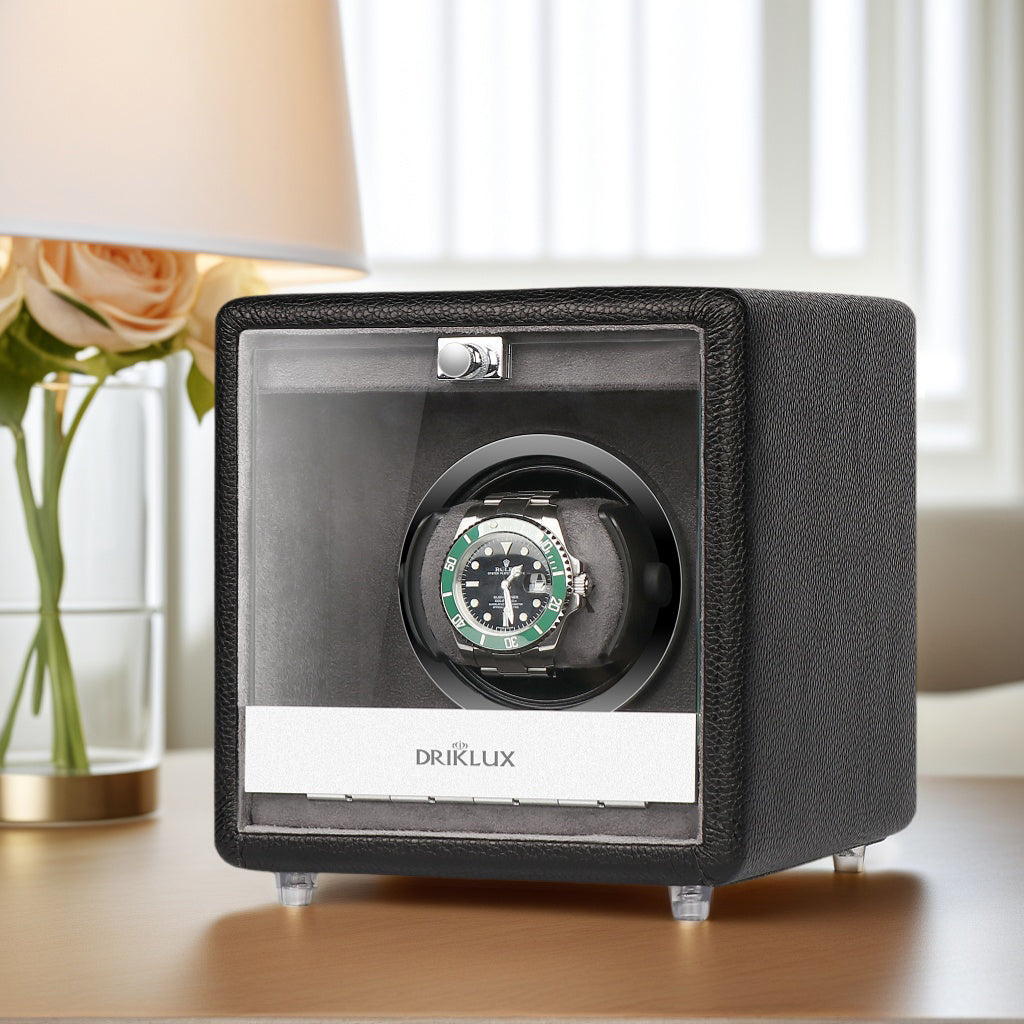
| Driklux | Mid-market / value-feature balance | Buyers who want adjustable settings without luxury pricing with deal silent in bedroom | Confirm TPD and direction before buying , and choice stepper brushless motor item |
Because many brands market by case finish rather than winding behavior, the most important spec is still the combination of TPD, direction, and rest intervals. For watches with a reserve indicator, the wrong setting can keep the watch running but still produce inconsistent reserve readings and unnecessary wear over time.
Many collectors benefit from understanding watch winder selection tips.
FAQs
What should I know about Setting Watch Winders for Power Reserve Indicators That "Jump"?
Power reserve indicators that “jump” are usually not a defect in the watch itself; they are a clue that the watch’s winding system, reserve display geometry, or winder settings may not be matching the movement’s needs. For collectors, the issue matters because the wrong winder setup can create misleading readings, incomplete winding, or unnecessary wear on a movement that should otherwise be stable and predictable.
What are the most common mistakes to avoid?
| Problem | What it looks like | Likely cause | Practical fix |
|---|---|---|---|
| Reserve hand jumps after mounting on a winder | The indicator moves in bursts instead of a steady decline or gradual refill | The watch is not seated squarely, the rotor is not coupling cleanly, or the winder is set too aggressively or too weakly | Re-seat the watch, confirm snug fit, and adjust TPD in small increments; test again for 8–12 hours. |
| Watch stops despite being on the winder | Power reserv |
What should I consider when buying?
A watch winder for a movement with a “jumping” power reserve indicator should be chosen for correct motion profile, not brute-force speed: the goal is to keep the mainspring topped up without over-cycling the watch or confusing a reserve display that advances in discrete steps rather than a smooth sweep. For collectors buying for models like the Rolex Submariner, Datejust, or Daytona, the safest approach is an adjustable winder with programmable TPD, selectable direction, and i
Conclusion
Mastering setting watch winders for power reserve indicators that "jump" ensures your luxury timepieces receive proper care. By investing in quality equipment and following best practices, you protect your investment for years to come.
Further Reading
For deeper understanding of the topics covered in this guide, explore these authoritative resources:
- Power reserve indicator - SEIKO WATCH — seikowatches.com
- Power reserve indicator — seikowatches.com
- Spring Drive — grand-seiko.com
Galerie de produits