

Understanding "Deadbeat Seconds" Complications And Winder Stability Patterns

Table of Contents
- Overview and Key Concepts
- Technical Specifications
- Expert Best Practices
- Common Challenges
- Buying Considerations
- FAQs
- Conclusion
Deadbeat seconds is a niche but highly meaningful complication because it delivers a one-second “tick” in a fully mechanical movement, and that visual cadence appeals to collectors who value precision theater as much as technical ingenuity. For serious buyers, the topic matters because it intersects movement architecture, service complexity, and how an automatic watch behaves when stored in a wind
You can find more information about maintaining your automatic watch in our guide.

Overview and Key Concepts
Deadbeat seconds is a niche but highly meaningful complication because it delivers a one-second “tick” in a fully mechanical movement, and that visual cadence appeals to collectors who value precision theater as much as technical ingenuity. For serious buyers, the topic matters because it intersects movement architecture, service complexity, and how an automatic watch behaves when stored in a winder for long periods.
A deadbeat seconds watch advances the seconds hand once per second in distinct jumps instead of a smooth sweep. The effect mimics quartz, but the mechanism is mechanical, usually achieved with a remontoire, secondary escapement, or star-and-flirt system.
That makes deadbeat seconds one of the most “anti-obvious” complications in horology: the watch looks simple at a glance, but the movement underneath is often more complex than a standard sweep-seconds caliber. Rolex’s historical Tru-Beat reference 6556 is the best-known mainstream example, and it used a modified automatic movement derived from the 1030 family.
Collectors chase deadbeat seconds for three reasons:
- It is mechanically unusual and conversation-worthy.
- It has strong historical cachet, especially through Rolex Tru-Beat and other vintage examples.
- It rewards owners who understand movement behavior instead of just brand prestige.
Many collectors benefit from understanding choosing the right watch winder.
Professional collectors often choose single watch winder options.
Technical Specifications
A deadbeat seconds complication is a mechanical seconds display that advances in one clean one-second jump, instead of sweeping continuously like a standard automatic movement. For collectors, the key takeaway is that this is still a mechanical watch behavior, usually achieved with an added mechanism such as a remontoire, secondary escapement, or spring-loaded lever, and it can make the watch feel more “quartz-like” even when the movement is fully mechanical.
Deadbeat seconds itself does not materially change how a watch should be wound; the dominant factors are the movement’s power reserve, winding architecture, rotor efficiency, and lubrication state. What it can change is the perceived stability of timekeeping on a winder, because a jumping seconds display makes any pause, amplitude drop, or inconsistent rotation look more abrupt than on a smooth-sweeping movement.
- Mechanical deadbeat seconds is typically used in highly engineered watches, so a good winder should prioritize consistent low-torque rotation rather than aggressive cycling.
- A winder that over-rotates or uses jerky start-stop programming can be counterproductive on delicate or heavily finished movements.
- For stable running, choose a unit with adjustable turns per day (TPD), bidirectional/unidirectional modes, and a secure pillow that does not compress the case crown-side.
Rolex examples are useful because many collectors compare winding needs by movement family. The Caliber 3135 is the long-running automatic workhorse found in models such as the Submariner Date, many Datejust references, and other Rolex sports and dress pieces. The newer Caliber 3235 appears in modern references including the Submariner Date 126610 and Datejust 41, and is regulated to roughly -2 to +2 seconds per day in the cased watch, with about 70 hours of power reserve in current reference summaries.
Practical implications:
- Caliber 3135: dependable, tolerant, and widely supported by quality winders; a moderate TPD setting is usually the safest default for daily rotation.
- Caliber 3235: benefits from similarly moderate winding, but owners often notice sharper responsiveness to movement quality because the newer escapement and longer reserve are designed for stable, efficient running.
- Submariner and Datejust owners generally want a winder with simple, repeatable programs rather than “smart” motion gimmicks.
- Daytona is a special case because the modern Rolex Daytona is primarily a chronograph and not the classic automatic date sports model; if you are handling a Daytona variant, verify the exact caliber and whether the specific reference is automatic before putting it on a winder.
For detailed guidance, see our article on proper watch care techniques.
Consider a 4 watch winder case efficient maintenance durability for optimal results.
Expert Best Practices
Deadbeat seconds watches reward careful winding and stable rest patterns more than standard automatics, because the complication adds mechanical complexity and can be more sensitive to torque consistency, amplitude, and shock. For a collector-focused Driklux section, the practical takeaway is simple: choose a winder that keeps the watch moving enough to preserve readiness, but not so aggressively that it introduces unnecessary wear or unstable case movement.
Deadbeat seconds, also called jumping seconds, makes the seconds hand advance in exact one-second steps instead of sweeping smoothly. Some implementations use a remontoire or other constant-force architecture to regulate the jump, while others rely on a separate gear train or secondary mechanism to create the crisp tick.
This matters because the complication is not just cosmetic. It adds additional parts and tighter tolerances, so the watch can be more sensitive to lubrication, servicing intervals, and low-power conditions. In collector terms, that means a deadbeat seconds watch is often less forgiving of poor storage, rough handling, or an underperforming winder than a basic automatic.
A watch winder does not need to mimic your wrist perfectly; it needs to maintain a controlled, repeatable motion cycle with stable case support. The best units for a deadbeat seconds piece are the ones that avoid wobble, slip, and inconsistent rotation timing, because unstable support can create unnecessary lateral stress while doing nothing useful for long-term readiness.
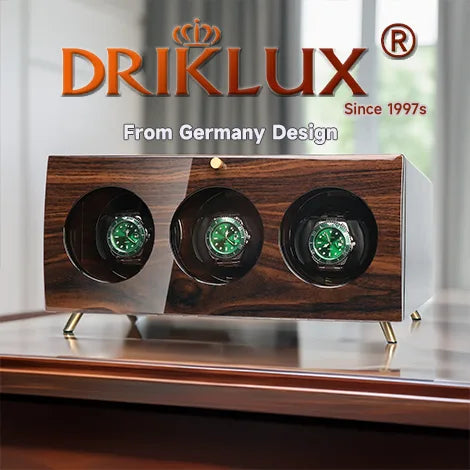
For this reason, collector-grade winders from Driklux, Wolf and Orbita are often preferred over generic units because they emphasize better case retention, programmable behavior, and more consistent motion control. For Example, Driklux's T series with stepper brushless moter which is most slient on bedroom when you sleep. as for Wolf’s Axis line, for example, is positioned in the lower-to-mid price tier in some listings, while higher-end Wolf models like the Viceroy and Roadster move into the premium range. Orbita’s lineup spans from roughly the mid-hundreds for compact models to well into premium territory for larger or specialty pieces.
You can find more information about optimal TPD settings for your watch in our guide.
Consider a stylish 6 watch winder box with extra for optimal results.
Common Challenges
Deadbeat seconds is a mechanical complication in which the seconds hand advances in discrete one-second jumps rather than a smooth sweep, and it is usually implemented with a star-and-flirt mechanism or a one-second remontoire. Because it adds moving parts and load to the gear train, the main challenges are energy loss, irregular jumps, reduced amplitude, and sensitivity to servicing quality.
For a premium-winder blog, the most useful angle is this: deadbeat seconds is not a “better” movement, but a more demanding one. The complication is prized for legibility and horological character, yet it can be more vulnerable to setup errors and winding-related stability issues than a standard sweep-seconds movement.
| Problem | What it looks like | Why it happens | How to solve it |
|---|---|---|---|
| Incomplete jump | The seconds hand hesitates, lands short, or fails to snap cleanly | Too little stored energy, weak lubrication, wear in locking parts, or shock-related misalignment | Fully service the movement, clean and relubricate the escapement and jump mechanism, and check for worn jumper springs or release components. |
| Irregular or “soft” ticking | Some jumps feel crisp while others look sluggish | Energy delivery is inconsistent; friction varies as the mechanism cycles | Have a watchmaker inspect the release geometry and tensioning elements; a properly regulated deadbeat system should lock and release consistently. |
| Amplitude drop / timing instability | Rate becomes less stable, especially when power reserve runs down | The complication adds load to the escapement, reducing energy delivered to the balance | Keep the watch well wound, service it on schedule, and avoid letting it run too close to empty power reserve. |
| Excess vibration at the jump | The jump appears harsh or noisy | The jump energy is too aggressive or the mechanism is out of tune | Recalibrate the jumper tension; if the watch is on a winder, reduce agitation by using gentler rotations and shorter sessions. |
| Creeping seconds hand before the jump | The hand subtly moves forward before each tick | This is a known trait of some true deadbeat constructions because the star wheel advances gradually before release | This is not usually a fault; it is a construction characteristic, not necessarily a defect. |
| Wear from poor servicing | The complication degrades faster than expected | Additional gears, springs, and tolerances make the system sensitive to wear and lubrication loss | Use a watchmaker experienced with high-complication mechanical movements, and do not extend service intervals beyond the maker’s guidance. |
Deadbeat seconds watches are usually more sensitive to stable energy delivery than ordinary three-hand movements, so the winder’s job is not just to keep the watch running, but to keep it running consistently. If the movement is allowed to sit too long or is wound too aggressively, the deadbeat mechanism may show inconsistent snaps or timing drift because the escapement is already operating with tighter energy margins.
For that reason, the best winder behavior is typically steady, moderate cycling rather than high-speed, high-turn agitation. In practical terms, a premium winder should avoid sudden reversals, unnecessary over-rotation, and long periods of pause that let a complication-dependent movement drift into a low-amplitude state.
Many collectors benefit from understanding selecting a quality watch winder.
Professional collectors often choose 4 watch winder for automatic timepieces reliable.
Buying Considerations
A deadbeat seconds watch is a mechanical watch whose seconds hand jumps once per second, rather than sweeping continuously, and the effect is achieved through an added mechanical system such as a remontoire, secondary escapement, or other release mechanism. For a buying guide, the key decisions are movement quality, brand pedigree, case/dial legibility, and—if you plan to use a winder—gentle, stable rotation settings that do not overstress the watch’s winding system.
-
A normal mechanical watch’s seconds hand typically advances several times per second because the balance wheel oscillates at 5 to 10 beats per second.
-
A deadbeat seconds watch converts that motion into a crisp one-second jump, which improves visual legibility and gives the watch a quartz-like rhythm while remaining fully mechanical.
-
The complication is technically demanding because the mechanism must store and release energy in a controlled way without compromising timekeeping stability.
-
It is one of the most recognizably “nerdy” complications in horology because it intentionally makes a mechanical watch behave like a quartz watch, but by mechanical means.
-
Historically, deadbeat seconds were valued for precise reading of seconds in scientific or observational contexts, so the complication carries both technical and historical credibility.
You can find more information about watch winder buying guide in our guide.
FAQs
What should I know about Understanding "Deadbeat Seconds" Complications and Winder Stability Patterns?
Winder stability is not just about keeping a watch moving; it is about keeping it moving without introducing unnecessary wear, poor clutch engagement, or inconsistent torque delivery. Premium winders such as Wolf, Orbita, Everest Bands, and Driklux are frequently chosen because they offer adjustable turns per day and direction control, which lets the owner match the watch’s actual winding behavior instead of forcing a generic cycle.
What are the most common mistakes to avoid?
For a premium-winder blog, the most useful angle is this: deadbeat seconds is not a “better” movement, but a more demanding one. The complication is prized for legibility and horological character, yet it can be more vulnerable to setup errors and winding-related stability issues than a standard sweep-seconds movement.
What should I consider when buying?
What deadbeat seconds means in practice
Conclusion
Mastering understanding "deadbeat seconds" complications and winder stability patterns ensures your luxury timepieces receive proper care. By investing in quality equipment and following best practices, you protect your investment for years to come.
Further Reading
For deeper understanding of the topics covered in this guide, explore these authoritative resources:
- What Is Deadbeat Seconds? | Watch Complication Explained — the1916company.com
- Announcing The S2 Deadbeat Seconds — garrick.co.uk
Galería de productos