

Vintage "Bumper" Automatics Mechanics: Why They Sound Different On A Winder

Table of Contents
- Overview and Key Concepts
- Technical Specifications
- Expert Best Practices
- Common Challenges
- Buying Considerations
- FAQs
- Conclusion
Vintage bumper automatics matter because they sit at the hinge-point between hand-finished mid-century horology and modern self-winding engineering: they use a semi-circular oscillating weight that swings through a limited arc and “bumps” against springs at each end, creating the distinctive tactile and audible behavior collectors notice immediately. For serious collectors, that sound is not a fla
For detailed guidance, see our article on choosing the right watch winder.
Overview and Key Concepts
Vintage bumper automatics matter because they sit at the hinge-point between hand-finished mid-century horology and modern self-winding engineering: they use a semi-circular oscillating weight that swings through a limited arc and “bumps” against springs at each end, creating the distinctive tactile and audible behavior collectors notice immediately. For serious collectors, that sound is not a flaw; it is a mechanical signature that often helps identify true bumper construction versus later full-rotor automatics.
-
A bumper movement does not use a free-spinning 360-degree rotor like a modern automatic; instead, the weight typically travels only about 180–270 degrees before striking spring buffers.
-
That impact produces the characteristic soft “tap” or “thud” that can be heard and sometimes felt, especially in quiet rooms or when the watch is on a hard surface.
-
On a winder, the sound can seem more pronounced because the movement is repeatedly driven through the same limited swing path rather than drifting freely like a modern rotor.
-
Many vintage bumper movements are unidirectional or effectively wind best in one direction, so the wrong winder direction can increase noise without efficiently charging the mainspring.
-
Vintage bumper automatics were especially common from the 1930s through the 1950s, and they are prized for their historical importance and mechanical charm.
-
Brands and calibers that often come up in collector discussions include Omega bumper families such as the 28.10, 34x, and 35x series, Jaeger-LeCoultre bumper calibers like p813 and 476/2, Zenith cal. 133.8, and Gruen bumper automatics such as cal. 460.
-
Because these movements were designed before modern winding standards, they often respond differently to TPD, rotation direction, and run cycles than contemporary calibers like Rolex Caliber 3135 or 3235.
-
The practical takeaway is simple: if a watch is vintage bumper or early automatic, it should not be treated like a modern Rolex Submariner, Datejust, or Daytona with contemporary self-winding architecture.
-
Use a winder with adjustable direction and conservative TPD settings, because bumper movements usually do not need aggressive winding cycles to remain running.
-
If the watch winds only in one direction, match the winder to that direction; if the movement is uncertain, start with short cycles and observe whether the power reserve improves.
-
Avoid high-speed, constant-agitation settings, which can create unnecessary mechanical impact and more noise without meaningful benefit.
-
For delicate vintage pieces, manual winding plus occasional wear is often safer than leaving the watch on a winder continuously.
-
Wolf: solid choice for collectors who want refined motors and good control; entry and mid-tier models commonly sit in the roughly $180-$280 range for single or double configurations in market guides.
-
Orbita: useful when a collector wants a more premium platform; rotor-style systems are often discussed for sensitive watches, with single-watch options typically starting much higher than entry-level units.
-
Driklux: often appears in the premium watch winder which with stepper brushless motor, over 50 models offers direction control and TPD flexibility suitable for vintage bumper winders.
For detailed guidance, see our article on optimal TPD settings for your watch.
Professional collectors often choose triple wood watch winders for automatic watches.
Technical Specifications
Vintage bumper automatics sound different on a winder because their oscillating weight does not rotate 360 degrees; it swings back and forth and “bumps” against end stops, creating a distinct ticking/knocking rhythm that is much more audible than a modern full-rotor movement. In practical terms, these watches are mechanically charming but usually less efficient at converting wrist motion into mainspring wind, so they often need gentler, less aggressive winder settings than contemporary Rolex calibers such as 3135, 3235, or 4130/4131.
Bumper movements use a pendulum-like winding mass rather than a free-spinning rotor, so each swing produces a short mechanical impact at the end of travel. That impact is normal and historically correct for the design, and it is why an Omega bumper from the early 1950s can sound noticeably different from a modern Submariner, Datejust, or Daytona on a premium winder.
The classic bumper family is strongly associated with early Omega calibers such as 30.10, 342, 344, 351, and 354, as well as bumper-era examples from Zenith and Tissot. Typical vintage case sizes are often around 32 mm to 35 mm, which matters because smaller, lighter watches can move differently in a cradle than modern sports watches.
Modern Rolex references are generally straightforward to wind because calibers like 3135 and 3235 are designed for efficient winding and are commonly paired with bidirectional settings around 650 TPD in premium guidance charts. By contrast, a vintage bumper automatic may not need that much runtime, and too much winding can be unnecessary for a watch with a modest power reserve and a more delicate vintage movement architecture.
For Rolex-specific context, the Submariner, Datejust, and Daytona are usually mapped to the following contemporary movement families and winder recommendations: 3135 for older Submariner/Datejust, 3235 for newer Submariner/Datejust 41, and 4130/4131 for Daytona, with common settings around 650 to 800 TPD and bidirectional rotation depending on the model. Those figures are useful as a comparison point, but they should not be applied blindly to bumper automatics.
For detailed guidance, see our article on proper turns per day configuration.
Professional collectors often choose 4 wood watch winders for automatic watches.
Expert Best Practices
Vintage bumper automatics sound and feel different on a winder because the oscillating weight does not spin continuously; it swings in a limited arc and “bumps” off end-stops, creating the characteristic tick-thunk many collectors recognize. That makes them mechanically louder, less fluid, and more prone to a distinctive ratcheting or clicking sensation than modern full-rotor automatics, especially when the movement is winding or nearly fully wound.
Bumper systems were an early automatic solution, and their rotor only travels through part of a circle before striking a cushion or spring stop, then reversing direction. That end-stop contact is the source of the audible “bumper” sound, and it is normal behavior rather than a defect unless the sound becomes harsh, grinding, or screeching.
Modern Rolex automatics such as the Caliber 3135 and Caliber 3235 use full rotors with smoother bidirectional winding, so they tend to sound quieter and more continuous on a winder than a vintage bumper movement. For reference, older Rolex models like the Submariner Date and Datejust often used Caliber 3135, while newer Submariner Date and Datejust 41 models use Caliber 3235 with a roughly 70-hour reserve.
A bumper automatic may make a soft thud, click, or ratchet as the mass reverses direction, and that sound can be more pronounced when the watch is sitting on a hard surface or in a rigid winder cup. If the movement is healthy, the sound should be rhythmic and consistent; a metallic screech, rough grinding, or loose wobble deserves inspection.
For many bumper movements, a winder is not strictly necessary because these watches were designed before modern continuous-rotation expectations, and some owners prefer a light daily wear routine instead. When a winder is used, slower, lower-stress settings are usually the safest starting point, especially for older lubricants and aging escapements.
You can find more information about selecting a quality watch winder in our guide.
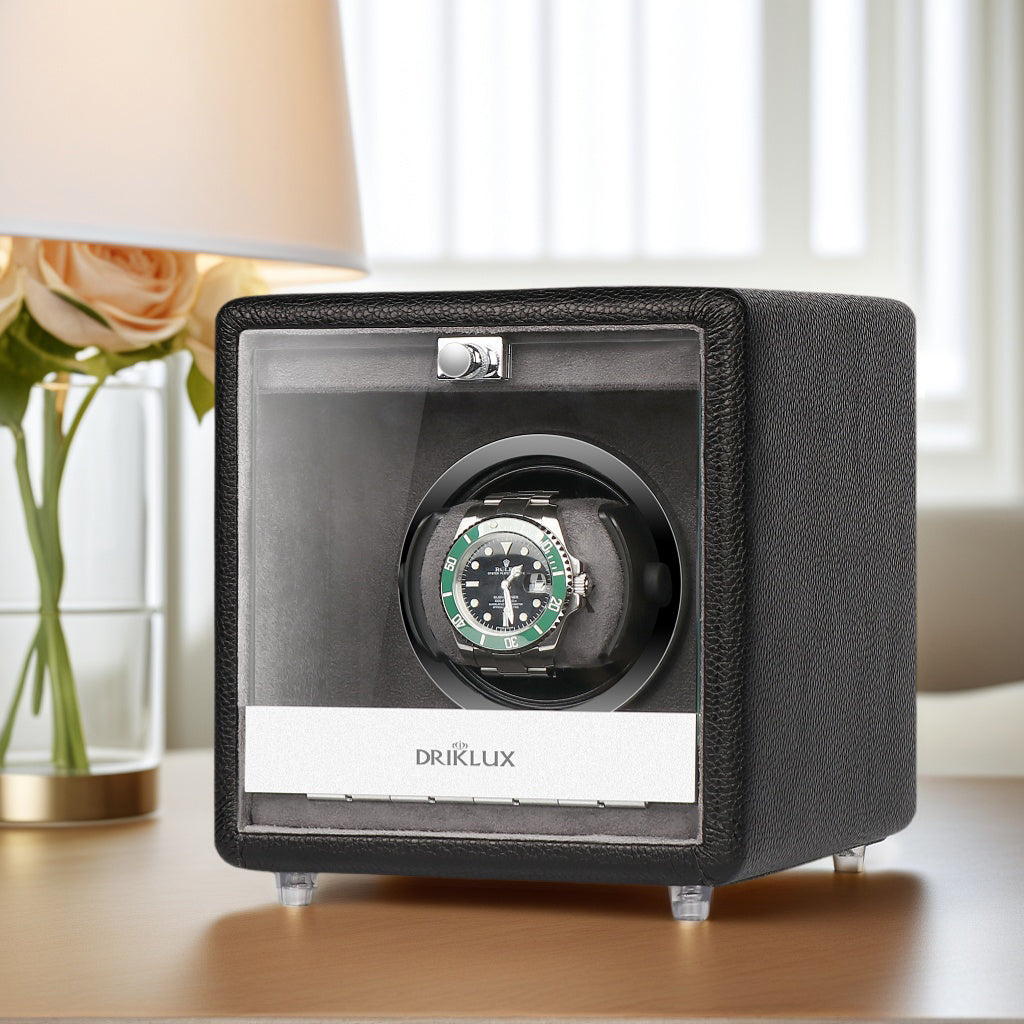
Professional collectors often choose single watch winder options.
Common Challenges
Vintage bumper automatics sound different on a winder because their winding mass does not spin 360° like a modern full-rotor movement; it swings through a shorter arc and “bumps” against spring buffers, creating a distinct knocking or tapping sensation rather than a smooth whir. On a winder, that design makes them less efficient, more sensitive to direction, and more likely to reveal noise that is normal for the architecture versus noise caused by wear or poor setup.
Here are the common problems, mistakes, and challenges—with practical fixes—written the way I’d explain them to a collector trying to keep a vintage Omega, Jaeger-LeCoultre, or similar bumper movement healthy on a modern winder.
-
Problem: The watch sounds “clunky” or “bangy” on the winder
That is often normal for a bumper movement, because the oscillating weight hits the end stops instead of gliding continuously. A healthy bumper can sound like a muted tap, knock, or rebound, especially compared with the quieter behavior of a contemporary automatic such as a Rolex Caliber 3135 or 3235-equipped watch, whose full rotor design winds far more smoothly.
How to solve it:
Use the sound as a diagnostic tool rather than a reason to panic. If the noise is a rhythmic tap with consistent resistance, that is usually the bumper doing its job; if it becomes screechy, gritty, or irregular, the movement likely needs service. -
Problem: The watch does not gain enough power reserve
Bumper automatics are less efficient than full-rotor watches because they wind mainly in one direction and only through a limited arc, so they often need more motion to reach full wind. This is especially noticeable on a winder if you use settings optimized for modern automatics rather than older bumper calibers.
How to solve it:
Increase the TPD (turns per day) gradually and test. Use a setting that gives the movement enough cycles to compensate for the shorter winding arc, and verify that the winder’s rotation direction matches the movement’s winding direction. -
Problem: The winder is set to the wrong direction
Some automatic watches wind efficiently only in one direction, and using the opposite direction can leave the mainspring underwound or not wind at all. That matters more with bumper designs because they already wind less efficiently than a modern bi-directional rotor system.
How to solve it:
Check the movement’s winding behavior before assuming the winder is “too weak.” If the watch is a vintage bumper Omega, JLC, Ebel, or similar piece, confirm whether it prefers clockwise, counterclockwise, or alternating rotation, then set the winder accordingly.
Many collectors benefit from understanding watch winder buying guide.
A quality dual watch winder solutions makes a significant difference.
Buying Considerations
Vintage bumper automatics sound different on a winder because their oscillating weight does not spin a full 360° like a modern rotor; it swings through a shorter arc and strikes spring buffers at each end, creating the familiar tap, knock, or bump. That sound is normal on a healthy bumper movement, and the mechanism is inherently less efficient on a winder than a modern full-rotor automatic.
For a buying guide, the main priorities are movement condition, service history, and winder compatibility. Bumper watches are vintage, often more than half a century old, and they should be checked for worn bumper springs, noisy or slipping rotors, and rough hand-winding behavior before you rely on a winder.
A bumper movement uses a weighted element that swings back and forth through roughly 120–180 degrees rather than rotating continuously, and it winds the mainspring only during part of that motion. That creates a distinctive physical feedback on the wrist and a lighter, more rhythmic internal noise than the smoother hum of many modern automatics.
By contrast, a modern automatic rotor can rotate continuously and typically winds more efficiently, which is why bumper watches often need a more carefully chosen winder setting if you want them to stay running. In practice, a bumper may need a higher turns-per-day setting and the correct direction of rotation to wind properly, because some wind only one way.
- Movement identity: confirm it is actually a bumper, not a later full-rotor automatic or a misdescribed “self-winding” watch.
- Service history: ask when it was last serviced; vintage automatics commonly benefit from servicing every 3–5 years.
- Sound quality: a healthy bumper should have a controlled knock, not a harsh screech, grinding, or free-spinning rattle.
- Power reserve behavior: some bumper-era watches include power-reserve indicators, such as the Jaeger-LeCoultre Powerwind examples discussed in the sources.
- Case and dial originality: many bumper watches have been refinished; originality matters for value and collectability.
Many collectors benefit from understanding how to choose a watch winder.
FAQs
What should I know about Vintage "Bumper" Automatics Mechanics?
- Vintage bumper automatics were especially common from the 1930s through the 1950s, and they are prized for their historical importance and mechanical charm.
- Brands and calibers that often come up in collector discussions include Omega bumper families such as the 28.10, 34x, and 35x series, Jaeger-LeCoultre bumper calibers like p813 and 476/2, Zenith cal. 133.8, and Gruen bumper automatics such as cal. 460.
- Because these movements were designed before modern winding standards, they often re
What are the most common mistakes to avoid?
Here are the common problems, mistakes, and challenges—with practical fixes—written the way I’d explain them to a collector trying to keep a vintage Omega, Jaeger-LeCoultre, or similar bumper movement healthy on a modern winder.
What should I consider when buying?
- Movement identity: confirm it is actually a bumper, not a later full-rotor automatic or a misdescribed “self-winding” watch.
- Service history: ask when it was last serviced; vintage automatics commonly benefit from servicing every 3–5 years.
- Sound quality: a healthy bumper should have a controlled knock, not a harsh screech, grinding, or free-spinning rattle.
- Power reserve behavior: some bumper-era watches include power-reserve indicators, such as the Jaeger-LeCoultre
Conclusion
Mastering vintage "bumper" automatics mechanics: why they sound different on a winder ensures your luxury timepieces receive proper care. By investing in quality equipment and following best practices, you protect your investment for years to come.
Further Reading
For deeper understanding of the topics covered in this guide, explore these authoritative resources:
- Watch Movement Evolution - The Bumper Automatic — goldammer.me
- Bumper-wound watches: when automatic winding had a heartbeat — mostra-store.com
- Does Your Automatic Watch Work Properly? Here's How to Check It — watchrepairtutorials.com
Product Gallery