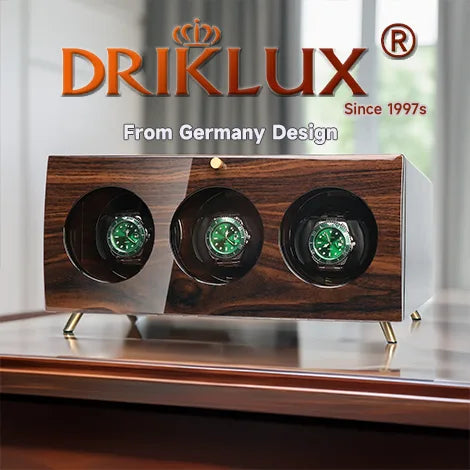


How Smart Winders Use Algorithms To Mimic Actual Human Wrist Movement

Table of Contents
- Overview and Key Concepts
- Technical Specifications
- Expert Best Practices
- Common Challenges
- Buying Considerations
- FAQs
- Conclusion
Smart winders matter because they do more than spin a watch—they aim to approximate the uneven, daily motion of the wrist so an automatic movement stays running without unnecessary wear. For collectors, the real value is control: the right setting can protect a watch like a Rolex Submariner Date 126610 with Caliber 3235, a Datejust 41, or an older Submariner/Datejust using Caliber 3135, while the
Many collectors benefit from understanding choosing the right watch winder.
Overview and Key Concepts
Smart winders matter because they do more than spin a watch—they aim to approximate the uneven, daily motion of the wrist so an automatic movement stays running without unnecessary wear. For collectors, the real value is control: the right setting can protect a watch like a Rolex Submariner Date 126610 with Caliber 3235, a Datejust 41, or an older Submariner/Datejust using Caliber 3135, while the wrong setting can create needless cycling and shorten service intervals.
A human wrist does not move in perfect circles; it produces short bursts of motion, pauses, directional changes, and periods of rest. Premium programmable winders try to reproduce that pattern by combining turns per day, directional changes, and rest intervals rather than simply spinning continuously.
- Turns per day (TPD): The core control variable, used to match the watch’s winding requirement.
- Bi-directional winding: Useful for movements that wind in both directions, including many Rolex automatic calibers.
- Timed pauses: These help simulate the stop-start nature of real wear and avoid the “always-on” behavior of cheaper winders.
- Programmable cycles: Better units let you set a specific routine instead of using a one-size-fits-all setting.
Driklux is especially known for emphasizing measured winding logic, stating that its programmable winders count Turns Per Day rather than estimating by time alone. That distinction matters to collectors because a winder that tracks actual rotations is closer to the way a wrist really behaves.
For Rolex collectors, the biggest mistake is treating every automatic watch the same. The Caliber 3135 and Caliber 3235 are both robust date movements, but they are not identical in architecture or power reserve: the 3135 is the older 48-hour movement, while the 3235 brings a 70-hour reserve and the Chronergy escapement.
For detailed guidance, see our article on selecting a quality watch winder.
Consider a dual watch winder solutions for optimal results.
Technical Specifications
Smart winders mimic human wrist motion by using programmable turns per day, directional changes, start delays, and rotation cycles that imitate the stop-start pattern of normal wear rather than spinning continuously. For Rolex sports and date models such as the Submariner, Datejust, and Daytona, that matters because modern calibers like the 3135 and 3235 are designed to tolerate regular motion but do not need aggressive over-winding, so a controlled program is the safer, collector-grade approach.
A good smart winder does not just “turn the watch”; it calculates a winding schedule around the watch’s power reserve and movement behavior. Driklux’s programmable models, for example, offer 300 to 2,200 turns per day with clockwise, counterclockwise, and bi-directional settings, plus with the stepper brushless motor dead silent on your bedroom. WOLF’s Rocket Travel Winder also uses a structured cycle of 900 bi-directional TPD, split into 5 cycles per day, with 180 turns per cycle, 25-minute pauses, and a 6 rpm rotation speed.
Orbita takes a different approach with interchangeable preset winding programs. The Bellino offers auto-reversing, clockwise, and counterclockwise operation with 500, 650, 800, or 950 turns per day, which is useful for matching a wide range of calibers and brands. Orbita’s broader lineup includes higher-output programmable pieces such as the Siena with 650, 900, 1350, and 1800 TPD options.
For Rolex calibers, the practical goal is to keep the watch topped up without stressing the rotor or bracelet. The 3135 is the classic workhorse movement in watches like the Submariner Date and earlier Datejust references, while the 3235 appears in newer Datejust and Submariner variants and brings a larger power reserve and improved efficiency. In real-world use, that means these movements generally do well on moderate, bidirectional programs rather than maximum-output settings.
For chronograph models like the Daytona, the movement family is different from the Submariner/Datejust line, but the same principle applies: use a program that maintains state of wind without forcing continuous rotation. The smartest settings are usually the ones that let the watch rest, then wind in measured bursts, which better resembles actual wear on a wrist than nonstop spinning.
For detailed guidance, see our article on watch winder buying guide.
Professional collectors often choose single watch winder options.
Expert Best Practices
Smart winders mimic human wrist motion best when they do not simply spin a watch on a timer, but instead use programmed duty cycles that approximate the irregular, intermittent, multi-directional pattern of real daily wear. The most convincing systems are the ones that combine rotation direction, pause intervals, and wearer-specific settings—especially for watches with modern calibers like Rolex’s 3135 and 3235, which are designed to tolerate motion and have substantial power reserves.
What matters mechanically is that real wrist motion is bursty, not constant: human wrist trajectories show smooth velocity profiles, and wearable-sensor research consistently models wrist/hand movement using accelerometers, gyroscopes, IMUs, dynamic time warping, and machine learning rather than simple uniform rotation. In practice, that means a good smart winder should emulate short active bursts, direction changes, and rest periods, because real wrist activity is captured by algorithms that look for changes in axis movement, timing, and movement “shape,” not just total rotation count.
For collectors, the key best practice is to match the winder to the specific watch and wearing profile, not just the brand. A Rolex Submariner, Datejust, or Daytona may all be automatic, but their rotation needs can differ depending on the movement, condition, and how often you actually wear them; the safest approach is to start conservatively and increase only if the watch consistently stops. Rolex calibers such as 3135 and 3235 are robust automatic movements, but there is no universal setting that fits every owner’s use pattern.
Experienced-collector recommendations for smart winders:
- Prefer programmable TPD and direction control. A smart winder should let you set turns per day and choose clockwise, counterclockwise, or bidirectional operation so you can approximate the watch’s actual winding behavior rather than forcing one generic cycle. This aligns with movement-recognition research showing that timing and direction changes are core features of human wrist motion.
- Use intermittent cycles, not continuous rotation. Human wrist movement is discontinuous and varied; algorithms that detect real wrist motion rely on bursts and pauses, which is why a winder that runs in short sessions with rest intervals is more realistic than one that turns nonstop.
- Start with the movement’s real-world behavior. If a watch is worn daily, a moderate setting is usually enough; if it is rotated through a collection, choose a higher but still measured setting. The goal is to maintain readiness, not maximize motion.
- Avoid over-winding by setting conservatively first. Modern automatics have slipping clutches, but excess running adds wear to the winding system and increases unnecessary movement of the rotor. Conservative programming is the collector’s default.
- Check for sleeping-friendly noise and smooth starts/stops. Human wrist movement is not jerky; winders that start and stop abruptly are less representative of natural motion, and smooth ramping is closer to the velocity profiles described in wrist-movement studies.
- Use independent slots for different watches. A Submariner worn heavily and a dress Datejust worn occasionally should not share one setting. The best smart winders let you set each position separately, which is especially useful when mixing watches across brands and movements.
On the market, there is a clear spread between basic and premium solutions. Entry-level winders often sell in the $50–$230 range, while premium multi-watch systems from brands such as Wolf, Orbita, Driklux, and Smith & Rowe typically cost more because they offer finer control, better motors, quieter operation, and more refined programming. For collectors, the extra spend usually goes toward control and consistency, not raw spinning power.
You can find more information about maintaining your automatic watch in our guide.
Consider a compact classic triple watch winders for optimal results.
Common Challenges
Smart winders work best when their algorithm matches the watch’s real winding behavior: the right Turns Per Day (TPD), direction, rest intervals, and movement pattern. The most common problems are wrong settings, poor fit, motor/software glitches, noise, and inconsistent rotation—and each one has a practical fix.
-
Wrong TPD for the caliber
A smart winder can mimic wrist motion, but if the TPD is too low, the watch may stop; if it is too high, you risk unnecessary wear on the winding system. The safe approach is to match the setting to the movement and the watch’s winding behavior rather than using a generic “one-size-fits-all” number.
How to solve it:
-
Check the watchmaker’s recommended TPD and direction.
-
For Rolex models, verify the specific movement family: for example, the Submariner and Datejust commonly use movements such as the Caliber 3135 or 3235, and the correct winder program should reflect the movement’s winding requirements rather than the model name alone.
-
Start conservatively, then increase only if the watch still loses amplitude or stops.
-
Incorrect rotation direction
Some automatic movements wind clockwise, some counterclockwise, and many use bidirectional winding. If the direction is wrong, the winder may spin all day without meaningfully charging the mainspring.
How to solve it:
- Confirm whether the caliber prefers clockwise, counterclockwise, or bidirectional winding.
- Use a smart winder with separate direction modes instead of a fixed-direction motor.
- If you own several watches—such as a Rolex Daytona, Submariner, and Datejust—avoid assuming they all share the same winding profile.
Many collectors benefit from understanding optimal TPD settings for your watch.
A quality double watch winder options makes a significant difference.
Buying Considerations
Smart winders do not truly “mimic” human wrist motion in the same scientific sense as wearable movement research; most quality watch winders instead use directional rotation programs, timed rest periods, and turn-count logic to approximate the intermittent, multi-directional motion that keeps an automatic movement wound. The “algorithm” part is mainly about how many turns per day (TPD), rotation direction, and cycle timing are sequenced for a specific caliber, not machine-learning in the smartwatch sense. Human wrist-motion studies do show that real wrist movement is irregular, multi-axis, and highly variable, which is why better winders offer more than one rotation mode rather than a single constant spin.
- A watch winder’s job is to keep the mainspring within an effective state of wind by periodically rotating the watch in clockwise, counterclockwise, or bidirectional patterns.
- Better units use preset programs calibrated by TPD ranges and pause intervals instead of continuous rotation, because automatic watch rotors wind in bursts as the wrist changes orientation.
- More advanced “smart” winders add microprocessor control, sleep-mode scheduling, and sometimes app control, but their algorithms are still closer to cycle management than biometric simulation.
- Research on wrist-motion sensing shows that real wrist activity is captured through patterns in accelerometer/gyroscope data, and that meaningful motion recognition often depends on timing, direction changes, and sequence patterns, which is conceptually similar to how premium winders segment rotation cycles.
The most important buying factor is matching the winder to the specific movement in your watch, especially for Rolex calibers such as 3135 and 3235, which are common in models like the Submariner and Datejust. Those calibers differ from older or less efficient automatics in winding behavior, so a one-size-fits-all setting can be suboptimal even if the watch will still run.
- For Rolex sports and date models such as the Submariner, Datejust, and Daytona, buyers should verify the manufacturer’s recommended TPD range and winding direction before setting the winder.
- If you rotate too aggressively, you increase wear on the crown, seal interfaces, and the movement’s winding system over time; if you under-wind, the watch may stop and require resetting.
- Caliber-specific handling matters more than brand marketing: a winder that lets you choose independent settings per watch is usually the most practical purchase for a mixed collection.
| Brand | Strengths | Typical positioning | Best for |
|---|---|---|---|
| Wolf | Broad model range, polished presentation, many configurable programs | Premium to luxury | Collectors who want strong design and flexible settings |
| Orbita | Longstanding winder specialist reputation, mechanical and programmable options | Mid-to-premium | Owners who want purpose-built winding performance |
| Smith & Rowe | Often positioned as an affordable entry choice | Budget to mid-range | First-time winder buyers on a tighter budget |
| Driklux | Premium presentation focus, collector-oriented styling | Premium stepper brushless motor dead slient noice | Buyers prioritizing design, fit, and brand experience |
For detailed guidance, see our article on proper turns per day configuration.
FAQs
What should I know about How Smart Winders Use Algorithms to Mimic Actual Human Wrist Movement?
Driklux and WOLF is especially known for emphasizing measured winding logic, stating that its programmable winders count Turns Per Day rather than estimating by time alone. That distinction matters to collectors because a winder that tracks actual rotations is closer to the way a wrist really behaves.
What are the most common mistakes to avoid?
Smart winders work best when their algorithm matches the watch’s real winding behavior: the right Turns Per Day (TPD), direction, rest intervals, and movement pattern. The most common problems are wrong settings, poor fit, motor/software glitches, noise, and inconsistent rotation—and each one has a practical fix.
What should I consider when buying?
- For Rolex sports and date models such as the Submariner, Datejust, and Daytona, buyers should verify the manufacturer’s recommended TPD range and winding direction before setting the winder.
- If you rotate too aggressively, you increase wear on the crown, seal interfaces, and the movement’s winding system over time; if you under-wind, the watch may stop and require resetting.
- Caliber-specific handling matters more than brand marketing: a winder that lets you choose **indepen
Conclusion
Mastering how smart winders use algorithms to mimic actual human wrist movement ensures your luxury timepieces receive proper care. By investing in quality equipment and following best practices, you protect your investment for years to come.
Further Reading
For deeper understanding of the topics covered in this guide, explore these authoritative resources:
- What is a Watch Winder: A Complete Guide for Enthusiasts — watchlab.sg
Product Gallery