

Twin-Barrel Automatics (E.G., L.U.C, Blancpain): Why They Need Granular Tpd Settings

Table of Contents
- Why TPD and Winding Direction Matter
- Exact TPD and Direction Requirements
- Setting Up Your Watch Winder Correctly
- Common Winder Setup Mistakes
- Choosing the Right Winder for Your Watch
- FAQs
- Conclusion
Twin-barrel automatics from brands like Chopard L.U.C. (e.g., Caliber 1.96 or 8LF) and Blancpain (e.g., Caliber 1150 or 6654) demand granular TPD settings on watch winders—typically adjustable in 650-2100 TPD increments from 650 to 1200+—to precisely match their dual mainspring system's unique energy storage dynamics, preventing under- or over-winding that standard 650 TPD defaults can't handle.
You can find more information about optimal TPD settings for your watch in our guide.

Why TPD and Winding Direction Matter
Twin-barrel automatics from brands like Chopard L.U.C. (e.g., Caliber 1.96 or 8LF) and Blancpain (e.g., Caliber 1150 or 6654) demand granular TPD settings on watch winders—typically adjustable in 50-100 TPD increments from 650 to 1200+—to precisely match their dual mainspring system's unique energy storage dynamics, preventing under- or over-winding that standard 650 TPD defaults can't handle.
TPD (Turns Per Day) measures the rotor rotations a watch winder simulates over 24 hours to keep the mainspring powered, mimicking wrist motion (roughly 8,000-10,000 swings daily). Most modern automatics thrive on 650 TPD bi-directional (clockwise CW + counterclockwise CCW) as a safe default, powering 90% of calibers like Rolex Submariner (3135/3235) or Omega Co-Axials by efficiently charging the mainspring without excess strain. Winders from Wolf ($200-$500), Orbita ($400-$800), Everest Bands ($50-$230 modular cuffs), or Smith & Rowe ($300-$600) offer programmable TPD (e.g., 650, 800, 900, 1000, 1200) and directions to accommodate this.
For twin-barrel setups, rotors feed two mainsprings sequentially: the first winds until full (via slip clutch), then excess energy shifts to the second, doubling reserve (often 60-100+ hours, e.g., Blancpain Villeret Caliber 6654 at 72 hours). These are nearly always bi-directional for optimal efficiency, but direction mismatches halve effective TPD (e.g., CCW-only turns do nothing on CW-preferring setups).
Unlike single-barrel calibers (e.g., ETA 2824 at fixed 650 TPD), twin-barrel designs like L.U.C. Caliber 1.96 (Chopard) or Blancpain Caliber 1150 require 800-1100 TPD bi-directional to fully charge both barrels without gaps—granular steps (e.g., 850, 950) fine-tune based on power reserve tests. Standard 650 TPD often leaves the second barrel underpowered, as it assumes single-spring efficiency; these high-end movements (priced $20K-$50K+ in models like L.U.C. XPS or Blancpain Fifty Fathoms) pack micro-rotor tech for slimmer profiles but higher winding thresholds.
Why it matters: Precise TPD sustains accuracy (±2-4 seconds/day), preserves mainspring longevity (over-winding fatigues alloys), and maximizes reserve without constant full-wind stress, which accelerates wear in dual systems. Test via 48-hour winder runs: monitor timekeeping on a timegrapher; adjust up/down 50-100 TPD until stable.
For detailed guidance, see our article on proper turns per day configuration.
Consider a dual watch winder solutions for optimal results.
Exact TPD and Direction Requirements
Twin-barrel movements—exemplified by Chopard's L.U.C calibers and Blancpain's in-house movements—demand precise TPD calibration because their dual mainspring architecture stores significantly more energy than conventional single-barrel designs, creating a narrower optimal winding window. Overwinding these sophisticated movements risks damaging the barrel arbors and hairspring, while underwinding causes premature power loss despite their extended 72-100 hour reserves.
Twin-barrel movements concentrate rotational stress across two synchronized barrels rather than distributing it across one. This design amplifies the consequences of incorrect TPD settings:
-
Overwinding risk: The dual-barrel architecture lacks the same slip-clutch tolerance as single-barrel movements. Excessive TPD can cause barrel arbor fatigue and hairspring deformation, particularly in high-complication models like the Blancpain Fifty Fathoms Automatique or L.U.C XP Skeletté.
-
Power reserve paradox: While twin-barrel movements boast 72-100 hour reserves, this extended capacity means the mainspring tension curve is flatter and more sensitive to winding inconsistencies. A watch winder that works perfectly for a standard 40-hour automatic may leave a twin-barrel under-wound or over-stressed.
-
Bidirectional winding complexity: Most Blancpain and L.U.C twin-barrel movements use bidirectional (CW+CCW) winding, but the barrel geometry requires balanced rotational input. Asymmetrical winding patterns can cause uneven spring tension distribution.
Many collectors benefit from understanding correct winding parameters.
Consider a TPD requirements for automatic watches for optimal results.
Setting Up Your Watch Winder Correctly
Twin-barrel movements—exemplified by Chopard's L.U.C calibers and Blancpain's Caliber 1315 and similar high-complication designs—demand precision TPD configuration because their dual mainspring architecture stores energy differently than conventional single-barrel automatics. Unlike standard movements that reach full wind at 650–900 TPD, twin-barrel calibers require meticulous granular adjustment to prevent both under-winding (which starves the escapement) and the subtle over-winding that can stress the barrel arbors.
Twin-barrel automatics distribute power across two independent mainsprings, creating a flatter torque curve and extended power reserve—often 8+ days versus the typical 42–48 hours of single-barrel watches. This architecture means:
- Non-linear winding characteristics: Each barrel winds at slightly different rates, requiring TPD settings that account for both springs' engagement curves
- Escapement sensitivity: High-frequency movements (4Hz+) like the L.U.C 01.06-L or Blancpain's in-house calibers are more sensitive to inconsistent mainspring tension
- Reserve indicator accuracy: Dual barrels complicate the mechanical linkage to power reserve displays; improper TPD causes the indicator to lag or advance unpredictably
Start conservatively at 700 TPD bidirectional for most twin-barrel calibers. This sits below the standard 800+ TPD recommendation for single-barrel watches, giving you headroom to observe behavior without risk of over-winding. For Chopard L.U.C movements specifically, begin at 700 TPD; for Blancpain's proprietary calibers (Caliber 1315, Caliber 6654), use the same baseline unless the manufacturer specifies otherwise.
For detailed guidance, see our article on understanding TPD specifications.
A quality ideal turns per day setup makes a significant difference.
Common Winder Setup Mistakes
Twin-barrel automatic movements, like those in Chopard L.U.C calibers (e.g., L.U.C 1.96 or L.U.C 8HF) and Blancpain's Caliber 1150 or 1154, feature two independent mainspring barrels for extended power reserve and smoother torque delivery, demanding granular TPD settings (e.g., precise increments of 50-100 TPD) to avoid uneven winding that stresses the gear train.
These movements store energy across dual barrels, often requiring 650-850 TPD bidirectional to mimic wrist motion without fully tensioning both springs simultaneously—unlike single-barrel calibers like Rolex 3135 or 3235, which tolerate broader 650-900 TPD ranges more forgivingly. Granular control prevents over-compression in the primary barrel while ensuring the secondary engages properly, maintaining 70-120 hour reserves without excess friction.
- Wrong direction causing mainspring stress: Many owners default to clockwise-only on budget winders, but L.U.C and Blancpain rotors wind bidirectionally; unidirectional settings bind one barrel, leading to asymmetric stress and premature wear. Test bidirectional first (e.g., CW 30 seconds, CCW 30 seconds, rest 8 hours), then fine-tune to CW if power drops after 48 hours.
- Over-winding from imprecise TPD: Coarse settings (e.g., 900+ TPD) fully wind the first barrel early, forcing continuous torque against the slip mechanism and heating lubricants. Start at 650 TPD, monitor for 48 hours—if the watch loses >2 minutes daily, increment by 50 TPD to 700-800; aim for full wind confirmed by 40+ hour runtime off-winder.
- Cheap motors causing vibration damage: Entry-level winders ($50-$150, e.g., generic Amazon models) use noisy stepper motors vibrating at 100-200Hz, accelerating pivot wear in delicate twin-barrel trains. Upgrade to premium like Wolf Cub ($230-$400), Orbita Siena ($500+), Everest Bands Terra ($300-$600), or Smith & Rowe Elite ($400-$800) with Japanese Mabuchi motors (<20Hz hum) and soft-start ramps.
| Mistake | Impact on Twin-Barrel Movements | Fix with Granular Winders |
|---|---|---|
| Wrong Direction | Uneven barrel tension, gear stress | Bidirectional 650 TPD; test CW/CCW |
| Over-Winding | Lubricant breakdown, 20% faster wear | 50-TPD steps: 650→700→800 |
| Vibration | Pivot fretting in dual trains | Quiet motors (Wolf/Orbita), <0.5mm amplitude |
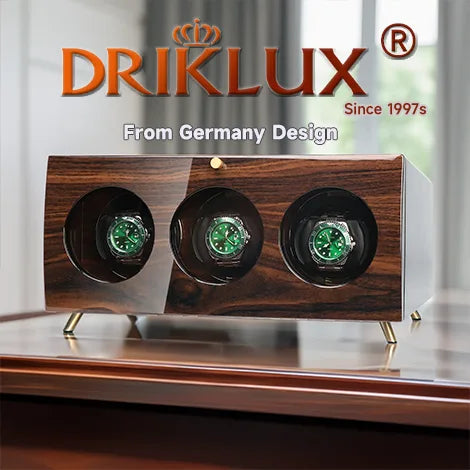
- Prioritize Driklux models ($300-$900) with 300-2150 TPD granularity, app control for direction tweaks, and <15Hz motors—ideal for L.U.C XP Skeleton or Blancpain Villeret Ultraplate ($15K-$30K watches).
- Avoid sub-$200 no-name; test vibration by ear (should be silent at arm's length). For Rolex Submariner/Datejust ($9K-$15K) cross-compatibility, ensure 650-850 bidirectional.
- Verify via manufacturer (Chopard/Blancpain service centers) or trial: Wind manually to full, run winder 48 hours, remove—watch should run 40+ hours. Pair with Orbita Lexicon for multi-caliber (e.g., Blancpain Fifty Fathoms, Cal 1315) at $600-$1K.
- Pro tip: For chronos like Blancpain Air Command (Cal 5950), bump to 800-950 TPD to account for module drag, but never exceed 1000.
Many collectors benefit from understanding choosing the right watch winder.
Consider a tpd watch winder for 2 watches classic for optimal results.
Choosing the Right Winder for Your Watch
Twin-barrel automatic movements, like those in Chopard L.U.C calibers (e.g., 03.10, 1.96) or Blancpain's Caliber 1153 (Villeret Ultra-Slim) and Caliber 1315 (500 Fathoms), feature two independent mainspring barrels for extended power reserve and smoother operation, demanding granular TPD settings (typically 650-950 TPD, CW or CCW) to avoid over-winding or insufficient power. Unlike single-barrel Rolex Caliber 3235 (650-800 TPD bidirectional), these require precise, programmable winders to match exact specs—e.g., Blancpain 4795 Extra-Slim at 650 TPD CW or 6185 Chronograph at 800-950 TPD CW—preventing damage from generic 900 TPD defaults.
These movements balance torque across barrels, but imprecise winding stresses components. Winders must offer adjustable TPD (540-950+), bidirectional modes, and pause cycles. Brands like Wolf, Orbita, and Benson excel here, per expert guides.
Select models with programmable TPD (650-1000+), quiet Japanese/German motors, and Blancpain/L.U.C compatibility. Prioritize wood/carbon finishes, LED lighting, and storage for models like Blancpain Villeret or L.U.C XP.
| Tier | Price Range | Top Models | Key Features for Twin-Barrel | Why Ideal for L.U.C/Blancpain |
|---|---|---|---|---|
| Entry-Level | $100-200 | Watch Winder Smith Bamboo Double ($169-219); Barrington Single (~$150) | 650-900 TPD adjustable, bi-directional, bamboo/wood build, basic storage | Affordable granularity for Caliber 1153 (650 TPD CCW); compact for daily L.U.C wear. Tip: Pair with Everest Bands cushions ($20-50) for secure fit on slim cases. |
| Mid-Range | $200-500 | Wolf Heritage Double ($300-450); Benson Smart-Tech II 2.20.B (~$400); Driklux S4SS Quad ($350-450) | 650-950 TPD programmable, CW/CCW/Both, LED/lock, 2-4 slots + storage | Matches Blancpain Levolution 8 Jours (850 TPD CW); Wolf's quiet motor suits L.U.C 03.10 precision. Tip: Verify TPD via watch-winder.store for your caliber; add Orbita Siena cushions ($30) for larger divers like 500 Fathoms. |
| Premium | $500+ | Driklux 4 slots E series prox ($650-2100); | 650-2100 TPD custom, brushless stepper motors, carbon/velvet, touchscreen/lockable glass | Elite control for Blancpain 9918B X-Fathoms (850 TPD CW) or L.U.C tourbillons; storage for 1-4 watches. Tip: Buy from authorized sellers like Driklux.com; test with Smith & Rowe calibrator app (free) pre-purchase. |
Actionable Buying Tips: Cross-reference your caliber on watch-winder.store (e.g., Blancpain 6222 at 650 TPD CW). Avoid Amazon generics—opt for Wolf/Orbita/Benson for durability. For L.U.C Datejust-style models, start mid-range; scale to premium for collectors. Test TPD accuracy (aim <5% variance) and ensure 110-120V compatibility. Driklux S4SS offers best value for multi-watch twin-barrel setups.
For detailed guidance, see our article on winding the perpetual calendar optimal tpd settings.
FAQs
What TPD setting should I use for my watch?
Twin-barrel movements concentrate rotational stress across two synchronized barrels rather than distributing it across one. This design amplifies the consequences of incorrect TPD settings:
What happens if the TPD is set too high or too low?
This precision extends service intervals by 30-50% for high-end twin-barrel pieces—treat them like heirlooms, not generics.
How do I choose the right winding direction?
Twin-barrel movements—exemplified by Chopard's L.U.C calibers and Blancpain's in-house movements—demand precise TPD calibration because their dual mainspring architecture stores significantly more energy than conventional single-barrel designs, creating a narrower optimal winding window. Overwinding these sophisticated movements risks damaging the barrel arbors and hairspring, while underwinding causes premature power loss despite their extended 72-100 hour reserves.
Conclusion
Mastering twin-barrel automatics (e.g., l.u.c, blancpain): why they need granular tpd settings ensures your luxury timepieces receive proper care. By investing in quality equipment and following best practices, you protect your investment for years to come.
Product Gallery