


Displaying "Dirty Dozen" Military Watches In Modern High-Tech Winders

Table of Contents
- Overview and Key Concepts
- Technical Specifications
- Expert Best Practices
- Common Challenges
- Buying Considerations
- FAQs
- Conclusion
The “Dirty Dozen” deserves a different display strategy from a modern Rolex or Omega. These twelve British Ministry of Defence–specified watches—Buren, Cyma, Eterna, Grana, Jaeger-LeCoultre, Lemania, Longines, IWC, Omega, Record, Timor, and Vertex—were built around compact, manually wound movements, not automatic winding systems. A modern high-tech winder can still be useful, but mainly as a contr
Overview and Key Concepts
The “Dirty Dozen” deserves a different display strategy from a modern Rolex or Omega. These twelve British Ministry of Defence–specified watches—Buren, Cyma, Eterna, Grana, Jaeger-LeCoultre, Lemania, Longines, IWC, Omega, Record, Timor, and Vertex—were built around compact, manually wound movements, not automatic winding systems. A modern high-tech winder can still be useful, but mainly as a controlled display, storage, and rotation-management device rather than as a mechanical necessity.
The name “Dirty Dozen” is a collector’s term for twelve Swiss manufacturers that produced watches to the British military’s W.W.W. specification during the Second World War. W.W.W. referred to “Wrist Watch Waterproof,” although surviving examples vary considerably in condition, originality, and effective water resistance.
The common specification was demanding for its era:
- Black dial with Arabic numerals
- Luminous hour and minute hands and markers
- Railroad-style minute track
- Subsidiary seconds at 6 o’clock on most examples
- Stainless-steel case
- Shatter-resistant crystal
- Broad-arrow military marking
- Screw-down or otherwise sealed case construction
- Shock-resistant, highly regulated movement
- Manual-winding caliber, generally with approximately 15 jewels
The watches were intended as practical military instruments, not luxury objects. Their value today comes from the combination of historical importance, recognizable design language, scarcity, and originality. A complete twelve-watch set is particularly challenging because Grana, IWC, and some early examples from other makers are much harder to locate in convincing, untouched condition than more frequently encountered Cyma, Record, or Timor watches.
Consider a Rolex watch winder recommendations for optimal results.
Technical Specifications
The “Dirty Dozen” were not automatic watches: the original British W.W.W. specification called for robust, hand-wound movements, generally 17 jewels, hacking seconds, fixed spring bars, a black luminous dial, broad-arrow markings, and cases typically around 35–40 mm. That distinction matters when choosing a modern high-tech winder: a powered winder cannot keep a manual-wind Dirty Dozen running unless the watch has been converted or fitted with an automatic movement.
The twelve contracted manufacturers were Buren, Cyma, Ebel, Enicar, Grana, IWC, Jaeger-LeCoultre, Lemania, Longines, Omega, Record, and Revue Thommen. Surviving examples vary substantially, so the movement—not merely the dial signature—should determine the display and care strategy.
| Manufacturer | Typical movement or identifying detail | Approximate case profile | Winder implication |
|---|---|---|---|
| Omega | Caliber 30T2 SC or related 30 mm hand-wound calibers | About 35 mm | Do not run on a motorized winder; wind manually |
| Longines | Caliber 12.68Z family | About 35–37 mm | Manual winding only; avoid unnecessary daily winding |
| IWC | Caliber 83 or related hand-wound movement | About 35 mm | Use a static display cushion |
| Jaeger-LeCoultre | Caliber 479 family, commonly 15-jewel manual winding | About 35 mm | Static display is safest |
| Cyma | Caliber 234 or related hand-wound movement | About 35 mm | No rotor-driven winding requirement |
| Record | Manual-wind movement, often with subsidiary seconds | About 35 mm | Static display; inspect dial lume before prolonged illumination |
| Buren, Ebel, Enicar, Grana, Lemania, Revue Thommen | Multiple period-specific hand-wound calibers | Roughly 35–38 mm | Verify the exact caliber before servicing or setting |
Published collector specifications commonly identify the Omega examples with a Caliber 30T2 hand-wound movement and Jaeger-LeCoultre examples with a manual-winding Caliber 479. The broad-arrow marking and fixed bars are historically significant, but they also make strap replacement more specialized than on a modern Rolex or Omega.
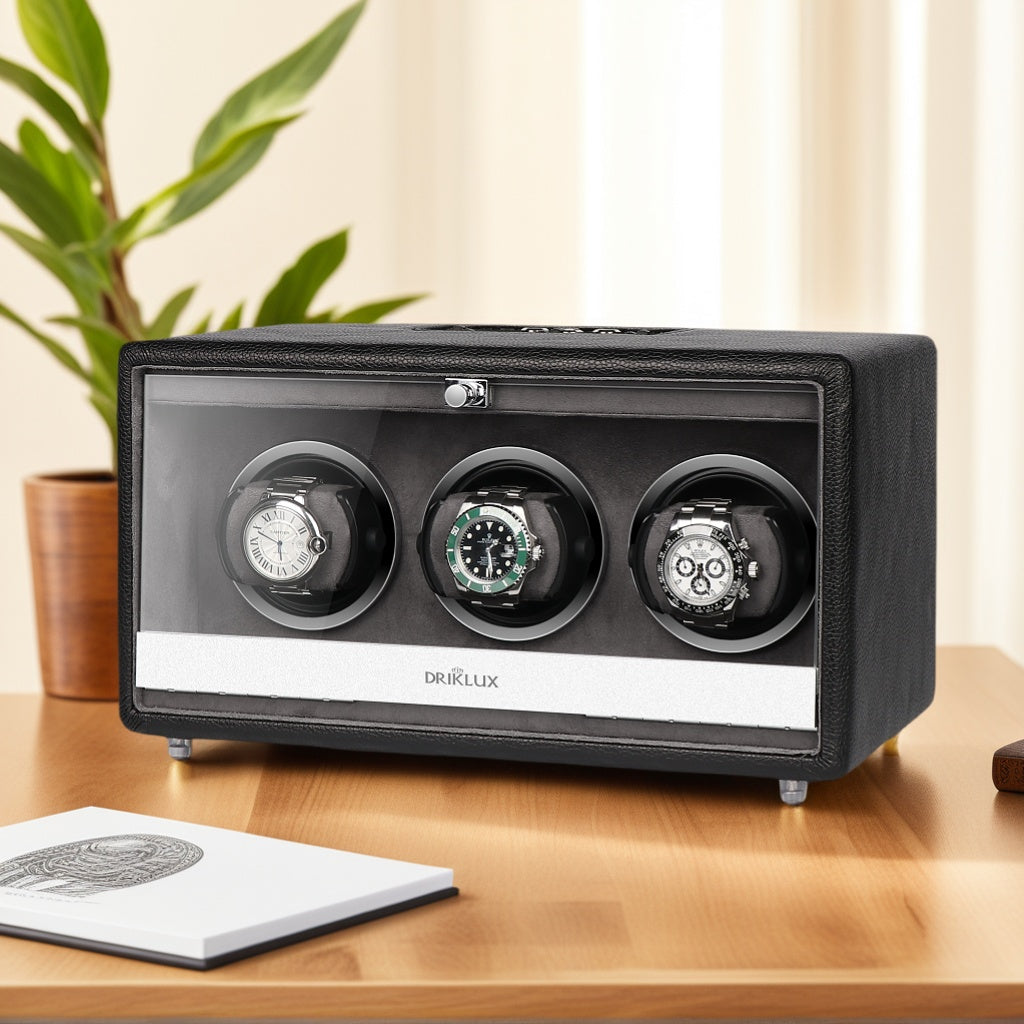
A watch winder rotates an automatic watch so its oscillating rotor winds the mainspring. A genuine Dirty Dozen watch has no automatic rotor, so a Driklux, Wolf, Orbita, or similar motorized unit will simply rotate the watch without winding it. Continuous rotation can also expose an aged movement to unnecessary positional changes, vibration, and wear.
Professional collectors often choose dual watch winder solutions.
Expert Best Practices
The original Dirty Dozen watches should be displayed as fragile historical instruments, not treated like modern sports watches. Their approximately 36–37 mm cases, acrylic crystals, radium-era luminous material, small-seconds layouts, and manually wound 15-jewel movements were designed for legibility and serviceability rather than continuous rotor operation. A modern winder is useful only when it can provide stable storage, controlled humidity, gentle cushioning, and a movement-specific winding program.
The twelve manufacturers generally associated with the Dirty Dozen are Longines, Vertex, IWC, Grana, Jaeger-LeCoultre, Lemania, Buren, Eterna, Timor, Omega, Cyma, and Record. Original examples normally show a black dial, Arabic numerals, a railway minute track, subsidiary seconds at six, luminous hands and markers, and a British Broad Arrow; the case back should typically carry “W.W.W.” plus issue and manufacturer serial information.
Most genuine Dirty Dozen watches are manual-wind, so a conventional automatic watch winder is not required to keep them running. A static watch box or display stand is usually the better choice for a watch that is worn occasionally. A winder becomes appropriate only when:
- The piece has been professionally serviced and the owner wants it running for regular wear.
- The watch has been converted or fitted with an automatic movement.
- The display installation includes a selectable “rest” mode rather than forcing continuous rotation.
- The owner accepts that running an unserviced vintage movement adds unnecessary wear.
A winder cannot compensate for dried lubricants, worn pivots, magnetism, or a weak mainspring. Before placing a Dirty Dozen watch in any motorized unit, verify beat rate, amplitude, beat error, and winding-system condition with a qualified vintage-watchmaker.
Professional collectors often choose single watch winder options.
Common Challenges
The original “Dirty Dozen” watches were wartime instruments, not luxury watches designed to spend years on a continuously rotating pedestal. Their black dials, broad Arabic numerals, small seconds, waterproof cases, and fragile period movements were built to survive field use—but many surviving examples now have aged lubricants, replaced parts, compromised seals, and radium-containing components. A modern high-tech winder can be useful, but only when it is configured as a controlled storage and display device rather than treated as a universal “keep-alive” machine.
The most serious mistake is placing a 1940s Dirty Dozen watch on a winder without establishing its mechanical condition. Longines, IWC, Jaeger-LeCoultre, Buren, Cyma, Eterna, Grana, Lemania, Record, Reconvillier, Timor, and Vertex examples may contain original or partially original movements, but decades-old oils can dry, migrate, or become abrasive. Collectors also encounter replacement wheels, non-original screws, worn pivots, and caseback damage from previous servicing.
Solution: have a qualified vintage-watch specialist inspect the movement before regular winding. Ask for:
- Beat error, amplitude, rate, and positional timing
- Condition of the mainspring and barrel
- Evidence of rust, dried lubricant, or excessive endshake
- Correct operation of the hand-setting mechanism
- Caseback and crown integrity
- Confirmation that the dial and hands have not been disturbed unnecessarily
If the watch has not been serviced for many years, use the winder only after a complete service—or store it stopped and wind it manually when inspection is needed. A winder cannot compensate for deteriorated lubrication.
Professional collectors often choose double watch winder options.
Buying Considerations
A genuine “Dirty Dozen” watch is not simply a vintage field watch. It is one of twelve watches commissioned for the British Ministry of Defence around 1944–45, produced by Buren, Cyma, Eterna, Grana, IWC, Jaeger-LeCoultre, Lemania, Longines, Omega, Record, Timor, and Vertex. These watches were built around a strict military specification: black luminous dials, Arabic numerals, steel cases, shatter-resistant crystals, fixed or reinforced spring bars, and hand-wound movements intended for dependable service.
That distinction matters when selecting a modern winder. Most original examples are manual-wind watches, so they do not need a winder to keep running. A motorized unit is primarily a display and storage device for a Dirty Dozen collection—not a necessity for operation. Excessive rotation, an overly tight cuff, magnetic motors, or uncontrolled humidity can do more harm than leaving the watch stopped.
For a single original Dirty Dozen watch, a high-quality watch box or non-magnetic display case is usually the more conservative choice. Use a winder when:
- The cabinet also stores modern automatic watches.
- The Dirty Dozen piece is displayed alongside watches such as a Rolex Submariner, Datejust, or Daytona.
- You want scheduled movement rather than continuous rotation.
- The winder has independently programmable modules and can be switched off for a vintage manual-wind watch.
- The watch has been inspected and serviced by a qualified vintage-watch specialist.
A vintage Omega, Longines, or Vertex should not be placed on a continuously rotating program merely because the cabinet has one. Its hand-wound movement has no automatic rotor to keep wound, and unnecessary running time increases wear on old pivots, jewels, and lubrication.
A quality maintaining your automatic watch makes a significant difference.
FAQs
What should I know about Displaying "Dirty Dozen" Military Watches in Modern High-Tech Winders?
This is where straps from specialists such as Everest Bands can be useful for modern Rolex watches, but they are not automatically appropriate for a Dirty Dozen example. Everest’s products are primarily designed around Rolex case geometry—including models such as the Submariner, Datejust, and Daytona—and should not be fitted to a vintage military watch unless the lug width, spring-bar profile, and buckle arrangement are confirmed. A period-correct or carefully matched two-piece leather strap
What are the most common mistakes to avoid?
The most serious mistake is placing a 1940s Dirty Dozen watch on a winder without establishing its mechanical condition. Longines, IWC, Jaeger-LeCoultre, Buren, Cyma, Eterna, Grana, Lemania, Record, Reconvillier, Timor, and Vertex examples may contain original or partially original movements, but decades-old oils can dry, migrate, or become abrasive. Collectors also encounter replacement wheels, non-original screws, worn pivots, and caseback damage from previous servicing.
What should I consider when buying?
- Continuous rotation for a hand-wound Dirty Dozen watch. It does not need a rotor-driven winding cycle.
- Universal high-TPD settings. They are convenient but unsuitable for mixed collections.
- Rigid cushions that stretch old leather straps. Vintage straps can crack or deform under constant pressure.
- Unshielded or poorly documented motors. Magnetic exposure is an avoidable risk.
- Strong interior lighting and heat. Prolonged heat can accelerate aging of lubricants, seals,
Conclusion
Mastering displaying "dirty dozen" military watches in modern high-tech winders ensures your luxury timepieces receive proper care. By investing in quality equipment and following best practices, you protect your investment for years to come.
Further Reading
For deeper understanding of the topics covered in this guide, explore these authoritative resources:
Galerie de produits