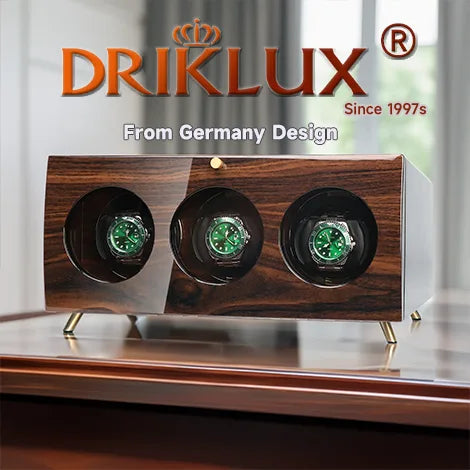


Complete Guide To The Perfect Tpd And Winding Direction For Junghans Watches

Table of Contents
- Understanding the Fundamentals
- Technical Specifications
- Best Practices
- Common Challenges
- Buying Considerations
- FAQs
- Conclusion
Turns Per Day (TPD) is the number of rotations a watch winder makes in 24 hours to keep your automatic watch fully wound, and selecting the correct TPD and winding direction is essential for maintaining your Junghans timepiece's accuracy and longevity.
For detailed guidance, see our article on optimal TPD settings for your watch.

Understanding the Fundamentals
Turns Per Day (TPD) is the number of rotations a watch winder makes in 24 hours to keep your automatic watch fully wound, and selecting the correct TPD and winding direction is essential for maintaining your Junghans timepiece's accuracy and longevity.
TPD measures how many times the watch winder's rotor rotates daily to generate kinetic energy that winds the mainspring. Every automatic watch contains a rotor that, when agitated, stores energy in the mainspring to keep the movement running. Different watch movements have varying energy requirements, which is why TPD settings are not universal across all brands and models.
Most automatic watches require between 500 to 1000 TPD to remain fully wound. However, the universal "safe zone" for the majority of modern automatic movements—including many Junghans calibers—is 650 TPD in bidirectional mode, which covers approximately 90% of the market.
For detailed guidance, see our article on proper turns per day configuration.
Professional collectors often choose dual watch winder solutions.
Technical Specifications
Junghans automatic watches primarily use ETA-based calibers like J800.1, J880.1, and J815.1 (hand-wound), with standard bi-directional winding rotors and power reserves of 38-56 hours. Optimal TPD (Turns Per Day) ranges from 650-800 for reliable self-winding, as these movements follow ETA 2824/7750 conventions (bi-directional, ~650-720 TPD ideal), though Junghans manuals emphasize manual full-winding via ~40 crown rotations for peak accuracy before relying on rotor action.
Junghans deploys a limited set of in-house modified ETA movements across collections like Max Bill, Meister, and Form. Winding direction is bi-directional for all automatics (rotor winds clockwise and counterclockwise), enabling use with most watch winders set to bi-directional mode. Hand-wound models require uni-directional clockwise crown winding.
| Caliber | Model Examples | Power Reserve | Beats/Hour | Jewels | Winding Type | Optimal TPD | Notes |
|---|---|---|---|---|---|---|---|
| J800.1 (ETA 2824 base) | Max Bill Automatic, Form A | 38 hours | 28,800 (4 Hz) | 25 | Bi-directional auto | 650-720 | Date function; viewable via exhibition caseback. Reliable, easy regulation. |
| J880.1 / J880.2 (ETA 7750 base) | Meister Chronoscope | 48-56 hours | 28,800 | 25 | Bi-directional auto | 650-800 | Chronograph; anti-magnetic (DIN 8309); robust, serviceable. |
| J815.1 | Meister Driver Hand Wind | 42 hours | N/A | N/A | Hand-wound (uni-directional clockwise via crown) | N/A (manual) | ~40 crown turns to full wind; no rotor. |
Many collectors benefit from understanding correct winding parameters.
A quality watch winder with 6 winding capacity makes a significant difference.
Best Practices
Junghans automatic watches typically require 650-800 Turns Per Day (TPD) on a watch winder, with clockwise (CW) winding for most chronograph models and bidirectional (both CW and counter-clockwise, CCW) for simpler automatics like Max Bill variants. Start with 650 TPD bidirectional as a safe default for unlisted models, adjusting based on the watch's accuracy over a few days: increase TPD if it runs slow, decrease if it gains time or shows overwinding signs like inconsistent power reserve.
TPD measures the full rotor rotations needed in 24 hours to maintain the mainspring's tension without manual intervention, ensuring optimal lubrication distribution and power reserve (often 38-42 hours for Junghans calibers like J800.1 or J880.1). Modern Junghans movements, in-house or ETA-based, feature bidirectional winding rotors in many cases, but chronographs demand higher TPD due to added complications.
Use this table for precise settings, drawn from verified Junghans movement data. Calibers like J880.1 (Piazza Chronoscope) specify CW at 800 TPD, while J800.1/J800.12 (Max Bill) use bidirectional at 650 TPD.
Many collectors benefit from understanding TPD requirements for automatic watches.
Consider a understanding TPD specifications for optimal results.
Common Challenges
For most Junghans automatic watches, use 650 TPD in bidirectional mode as the starting setting on a watch winder; increase to 800 TPD clockwise for chronographs or power-intensive calibers like those in the Max Bill or Meister collections. These parameters ensure the rotor generates sufficient kinetic energy for the mainspring without overwinding, as Junghans movements—often based on ETA or Sellita derivatives—typically require 650-800 rotations daily for optimal power reserve.
TPD (Turns Per Day) measures the rotations a watch winder provides in 24 hours to mimic wrist movement and keep the automatic rotor spinning. Junghans watches, known for precision German engineering since 1861, feature self-winding calibers such as the J800 (ETA 2824-based) or J880, which thrive in the 650 TPD "Goldilocks zone" to maintain accuracy without excess friction. Bidirectional winding (CW+CCW) suits most models, as it replicates natural rotor oscillation; clockwise-only applies to higher-demand complications.
- Standard models (e.g., Max Bill, Form A): 650 TPD bidirectional—covers 90% of Junghans automatics.
- Chronographs (e.g., Meister Chronoscope): 800 TPD clockwise, due to added modules increasing power needs.
- Power reserve indicators or date complications: Test at 650 TPD bidirectional; monitor for 48 hours and adjust ±50 TPD.
You can find more information about ideal turns per day setup in our guide.
A quality luxury 9 watch winder with added storage makes a significant difference.
Buying Considerations
Junghans automatic watches typically require 650 TPD in bidirectional mode for most models, with 800 TPD clockwise recommended for chronographs and power-intensive calibers to maintain optimal power reserve and accuracy.
- Standard Models (e.g., Max Bill collection): 650 TPD, bidirectional (alternating clockwise and counter-clockwise). This suits the majority of Junghans movements, which feature efficient self-winding rotors.
- Chronographs and High-Power Calibers: 800 TPD, clockwise only. These demand more rotations due to added complications like flyback functions or extended power reserves.
- General Range for Automatics: 650-800 TPD aligns with modern Junghans designs, preventing under- or overwinding while minimizing wear on the mainspring.
TPD (Turns Per Day) measures full rotor rotations in 24 hours needed to fully wind the mainspring. Bidirectional winding mimics natural wrist motion, while clockwise suits unidirectional rotors common in chronographs.
For detailed guidance, see our article on to wind your certina watch complete guide.
FAQs
What TPD setting should I use?
Junghans automatic watches primarily use ETA-based calibers like J800.1, J880.1, and J815.1 (hand-wound), with standard bi-directional winding rotors and power reserves of 38-56 hours. Optimal TPD (Turns Per Day) ranges from 650-800 for reliable self-winding, as these movements f
How do I choose the right winding direction?
Junghans automatic watches primarily use ETA-based calibers like J800.1, J880.1, and J815.1 (hand-wound), with standard bi-directional winding rotors and power reserves of 38-56 hours. Optimal TPD (Turns Per Day) ranges from 650-800 for reliable self-winding, as these movements f
What are common mistakes to avoid?
For most Junghans automatic watches, use 650 TPD in bidirectional mode as the starting setting on a watch winder; increase to 800 TPD clockwise for chronographs or power-intensive calibers like those in the Max Bill or Meister collections. These parameters ensure the rotor generates sufficie
Conclusion
Mastering complete guide to the perfect tpd and winding direction for junghans watches ensures your luxury timepieces receive proper care. By investing in quality equipment and following best practices, you protect your investment for years to come.
Produktgalerie