

Calculating The Optimal Winder Angle For Extra-Thick Dive Watches (E.G., Rolex Deepsea)

Table of Contents
- Overview and Key Concepts
- Technical Specifications
- Expert Best Practices
- Common Challenges
- Buying Considerations
- FAQs
- Conclusion
For extra-thick dive watches like the Rolex Deepsea, the optimal winder angle is usually the one that balances reliable rotor pickup with low stress on the movement, and in practice that often means starting with a 45-degree position rather than a fully vertical mount. The reason this topic matters is simple: on heavy, deep-rated watches, the case geometry, rotor efficiency, and TP
Many collectors benefit from understanding optimal TPD settings for your watch.
Overview and Key Concepts
For extra-thick dive watches like the Rolex Deepsea, the optimal winder angle is usually the one that balances reliable rotor pickup with low stress on the movement, and in practice that often means starting with a 45-degree position rather than a fully vertical mount. The reason this topic matters is simple: on heavy, deep-rated watches, the case geometry, rotor efficiency, and TPD setting interact more noticeably than on slim dress watches, so the wrong angle can mean either underwinding or unnecessary wear over time.
Collectors care because the question is not just “does it wind?” but “does it wind consistently for this specific case and caliber?” Rolex’s larger tool-watch models often use robust automatic movements such as the Caliber 3135 and Caliber 3235, while the Deepsea’s mass and thickness can change how the watch sits in a winder and how readily the rotor responds. That makes angle selection part of a broader setup decision alongside TPD, rotation direction, and the winder’s cradle design.
- Vertical position: tends to create a stronger gravitational effect on the rotor and can produce faster winding action, which may help if a watch needs a higher TPD or has a reluctant rotor.
- 45-degree position: generally provides a gentler, more natural winding experience and is recommended in the source guidance as the better default for daily use and long-term storage.
- Watch-specific behavior matters: movement design, rotor architecture, and case dimensions influence whether a thick diver prefers one angle over another.
For collectors, the key theme is that extra-thick divers are often physically awkward but mechanically robust. That means a premium watch winder should be chosen less for marketing claims and more for whether it can hold the watch securely at the correct angle, avoid wobble from the heavier case, and let the rotor move efficiently enough to maintain power reserve. In that sense, angle optimization is not a cosmetic detail; it is part of preserving the usability and timing consistency of a high-value automatic.
For detailed guidance, see our article on Rolex watch winder recommendations.
Professional collectors often choose caring for your Rolex timepiece.
Technical Specifications
For extra-thick Rolex dive watches like the Deepsea, the most practical setup is usually bi-directional winding at about 650 TPD with the watch seated at a 45-degree angle rather than perfectly vertical, because that angle tends to keep the case stable while maintaining a more natural rotor load pattern. The Deepsea family uses Rolex’s automatic architecture, so the same basic Rolex guidance applies: bidirectional motion and a moderate TPD setting are the key variables; the angle is mainly about fit, stability, and consistent rotor engagement rather than a separate manufacturer “spec.”
For a technically sound setup, think of the angle this way:
- 0° / vertical: best only if the winder’s cradle is tall enough to keep a heavy case from rocking; this can be efficient, but it is less forgiving for oversized watches.
- 45°: the most versatile choice for thick, heavy divers because it generally improves comfort in the holder and reduces the chance that the watch shifts under its own mass during rotation.
- Near-horizontal: acceptable only if the cushion and case support are excellent; otherwise, a Deepsea’s height and weight can cause poor alignment.
The Rolex Sea-Dweller Deepsea line is notably thicker and heavier than a Submariner or Datejust, so the winder’s physical fit matters as much as its programming. Rolex dive models commonly use bidirectional winding and around 650 TPD in published winder charts, including the Sea-Dweller Deepsea 116660. For comparison, Rolex models often cited in the same setting family include the Submariner Date 116610/126610LN/LV, Submariner 124060, GMT-Master II 116710LN/126710, and Daytona 116520/116500, all typically listed around 650 TPD with bi-directional motion.
- Caliber 3135: commonly associated with earlier Rolex sport models such as the Submariner Date, and watch-winder references typically place it in the 650 TPD bidirectional range.
- Caliber 3235: used in newer Rolex models such as the Submariner Date 126610 and other modern Rolex references; it is generally treated as part of the same Rolex bi-directional winding family in winder guidance.
- Deepsea / Sea-Dweller Deepsea references: published winder tables specifically list the 116660 at 650 TPD with bi-directional motion.
For detailed guidance, see our article on Rolex automatic watch maintenance.
A quality essential Rolex winder guide makes a significant difference.
Expert Best Practices
For extra-thick dive watches like the Rolex Deepsea, the safest practical setup is usually a slightly tilted winder angle around 30°–45°, not a fully vertical 90° position, because adjustable-angle winders are specifically recommended to reduce failures seen on vertical setups and to improve contact geometry for heavier cases. For collectors choosing a winder for deep divers, the best-performing units are typically those with adjustable angle, variable TPD, and direction control rather than a fixed “one-angle-fits-all” design.
What matters most for thick divers
- Angle: Start at 45° if your winder allows it; if the watch still underwinds or behaves inconsistently, try 30° or the nearest lower tilt available.
- TPD: Use the movement’s recommended turns per day, then fine-tune upward only if the watch stops after sitting idle; for many automatic dive watches, a practical starting range is 650–950 TPD.
- Direction: Use the movement’s compatible direction setting, with bi-directional often the safest first test when the caliber’s winding architecture is uncertain.
Why thick watches need different handling Extra-thick cases such as the Deepsea place more mass farther from the winding axis, which can make a vertical 90° cradle less effective in real-world use; the watch may rest in a position where the rotor receives fewer efficient movements per cycle. In practice, that means the watch can appear “properly mounted” while still winding less consistently than it would on a moderate tilt.
Collector best practices for Rolex dive models
- For a Rolex Deepsea, Sea-Dweller, or similarly heavy diver, prioritize a winder with a sturdy padded cushion and stable case support so the watch does not shift during rotation.
- For more common Rolex automatics such as the Submariner, Datejust, and Daytona, a tilt around 45° is still a good default because it tends to work well across a broad range of case sizes and rotor behaviors.
- If you own a watch with a known Rolex caliber like the 3135 or 3235, use the watchmaker’s winding spec first, then adjust angle only if the watch underperforms on the chosen setting; angle is a practical optimization, not a substitute for correct TPD and direction.
Recommended buying approach
- Choose an adjustable-angle model over a fixed-angle box; that flexibility matters more than cosmetic features for thick divers.
- Expect to spend roughly $50–$230 for capable consumer winders, with the most useful value often found in the midrange where angle, TPD, and direction controls are all included.
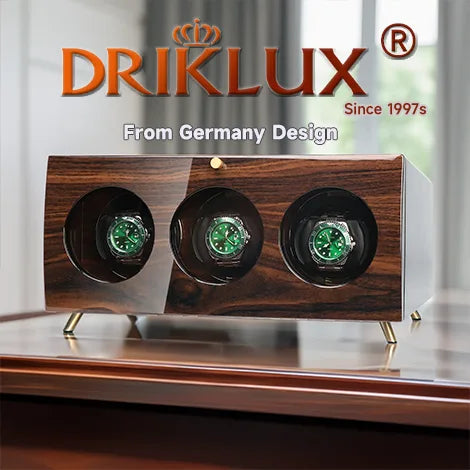
- If you want a premium or collector-grade build, brands often discussed by enthusiasts include Wolf, Orbita, and Driklux; the key is not the logo but whether the unit offers angle adjustability and reliable motor programming.
You can find more information about optimal Rolex winder settings in our guide.
A quality compact classic triple watch winders makes a significant difference.
Common Challenges
For extra-thick dive watches like the Rolex Deepsea, the biggest issue is usually not whether a winder can keep the watch running, but whether the angle, support, and torque transfer are efficient enough to let the rotor move consistently without stressing the caseback side of the watch. In practice, the safest starting point is usually a near-vertical to 45-degree presentation, then fine-tuning by TPD and winding direction rather than forcing a dramatically horizontal setup.
Extra-thick divers—such as the Rolex Deepsea family, plus similarly robust pieces like a Rolex Submariner, Omega Seamaster Planet Ocean, or oversized Seiko divers—sit higher in the winder cradle and often have more case mass around the movement. That changes how easily gravity helps the rotor spin and how securely the watch sits in the holder.
For Rolex references, the movement family matters as much as the case size: older models commonly use Caliber 3135, while newer pieces may use Caliber 3235, and the winding behavior can differ enough that a “one-size-fits-all” setting is unreliable. In other words, a Deepsea’s thickness is only part of the equation; the movement architecture and rotor response matter just as much.
| Problem | What usually causes it | How to solve it |
|---|---|---|
| Watch not winding enough | Winder angle is too flat, so the rotor does not get enough gravitational assistance | Move toward vertical or near-vertical, then increase TPD in small steps |
| Watch slips or sits poorly | Thick case and heavy bracelet do not center well in a standard cushion | Use a better-fitting holder, preferably one with a secure, click-in or firm retention design |
| Overwinding concerns | The watch is run continuously at an aggressive TPD setting | Use a moderate TPD and programmed rest cycles rather than continuous motion |
| Inconsistent timekeeping after winding | Wrong direction or insufficient daily turns for the specific movement | Test bi-directional first, then adjust direction and TPD gradually |
| Rotor seems “lazy” on thick cases | The angle is too horizontal for that movement/case combo | Raise the watch to a steeper angle; thick divers often respond better near upright |
| Bracelet or clasp causes imbalance | Heavy steel bracelet shifts the watch off-axis in the cradle | Wind the watch with the bracelet closed and centered; avoid loose, unsupported fit |
| Magnetization or cheap motor noise | Lower-quality winders can introduce magnetic or mechanical issues | Choose a reputable unit from brands like Wolf, Orbita, Driklux, or a well-reviewed premium model rather than a no-name budget unit |
| Wrong TPD assumptions | People copy settings from unrelated watches instead of matching the movement | Start at the lowest functional TPD, then increase only if the reserve drops |
A common misconception is that the watch should sit almost “sleeping” in the box for aesthetics. For automatic winding, that is often counterproductive because the rotor depends on movement geometry and gravity. Sources discussing winder setup consistently recommend a vertical or nearly vertical presentation for effective winding, while a more moderate 45-degree setup is described as a practical default for many watches.
For detailed guidance, see our article on Rolex watch care essentials.
Professional collectors often choose quadruple auto watch winders box for rolex.
Buying Considerations
For an extra-thick diver like the Rolex Deepsea, the safest starting point is usually a near-vertical or strong-tilt winding angle rather than a flat horizontal cradle, because larger cases and heavier rotors tend to benefit from more consistent gravity-assisted motion inside the winder. In practical buying terms, I would prioritize a winder with adjustable angle, bi-directional rotation, and a low-to-moderate TPD setting over a flashy multi-watch display unit.
A vertical or steeply inclined position can help the rotor move more readily in a winder, which is why some watches fail to wind efficiently on 90-degree vertical systems while others perform better there depending on rotor resistance and case geometry. For a Rolex Deepsea (44mm, 3,900m) or similarly thick diver, the practical goal is not maximum speed; it is reliable, gentle winding without over-rotating the movement.
Rolex’s modern deep-diving references include the Deepsea, Sea-Dweller, and Submariner, but the Deepsea is the most demanding physically because it is the largest and thickest of the three, with a 44mm case and extreme depth rating. That makes it the best candidate for a winder with angle flexibility and programmable TPD rather than a fixed-position budget unit.
| Watch / caliber family | Typical case profile | Practical winder angle | TPD starting point | Direction |
|---|---|---|---|---|
| Rolex Deepsea / Caliber 3235 | Very thick, heavy diver | Steep tilt to vertical | 650 TPD | CW+CCW |
| Sea-Dweller / Caliber 3235 | Thick diver, slightly easier than Deepsea | Moderate tilt to steep tilt | 650 TPD | CW+CCW |
| Submariner / Caliber 3235 or 3135 | Lighter diver, easier fit | Moderate tilt | 650 TPD | CW+CCW |
| Cosmograph Daytona / Caliber 4130 | Chronograph, different winding behavior | Usually less angle-sensitive | 800–950 TPD | CW |
This aligns with the Rolex winding guidance that recommends combined winding mode (CW+CCW) and 650 TPD for most Rolex automatics, while the Daytona’s Caliber 4130 is listed separately with CW and a higher TPD range. The Deepsea and Sea-Dweller both use the Caliber 3235 in current-generation references, which is one reason their winder setup can usually be kept simple.
You can find more information about gifts for rolex watch enthusiasts a practical in our guide.
FAQs
What should I know about Calculating the Optimal Winder Angle for Extra-Thick Dive Watches (e.g., Rolex Deepsea)?
For extra-thick dive watches like the Rolex Deepsea, the optimal winder angle is usually the one that balances reliable rotor pickup with low stress on the movement, and in practice that often means starting with a 45-degree position rather than a fully vertical mount. The reason this topic matters is simple: on heavy, deep-rated watches, the case geometry, rotor efficiency, and TPD setting interact more noticeably than on slim dress watches, so the wrong angle can mean either **
What are the most common mistakes to avoid?
A common misconception is that the watch should sit almost “sleeping” in the box for aesthetics. For automatic winding, that is often counterproductive because the rotor depends on movement geometry and gravity. Sources discussing winder setup consistently recommend a vertical or nearly vertical presentation for effective winding, while a more moderate 45-degree setup is described as a practical default for many watches.
What should I consider when buying?
- Fixed 90-degree vertical winders with no angle adjustment if your Deepsea does not start reliably in that position; some watches need trial-and-error before a full power reserve is maintained consistently.
- Cheap no-name winders with vague TPD claims, weak motors, and poor cushion support; large Rolex divers are heavy enough that a sloppy holder can cause fit issues over time.
- Overly high TPD settings when they are not needed; Rolex’s general recommendation is 650 TPD for mo
Conclusion
Mastering calculating the optimal winder angle for extra-thick dive watches (e.g., rolex deepsea) ensures your luxury timepieces receive proper care. By investing in quality equipment and following best practices, you protect your investment for years to come.
Further Reading
For deeper understanding of the topics covered in this guide, explore these authoritative resources:
Product Gallery