

Why Ostrich Leather Texture Dominates The Low-End-End Watch Winder Sector

Table of Contents
- Overview and Key Concepts
- Technical Specifications
- Expert Best Practices
- Common Challenges
- Buying Considerations
- FAQs
- Conclusion
Ostrich leather texture dominates the low-end watch winder sector because it delivers the visual language of luxury at a cost structure that is far easier to mass-produce than genuine exotic materials. For collectors, that matters because it explains why brands like Driklux, and retail channels such as WatchWinderUSA, can offer ostrich-textured winders as an accessible “premium look” alterna
You can find more information about choosing the right watch winder in our guide.
Overview and Key Concepts
Ostrich leather texture dominates the low-end watch winder sector because it delivers the visual language of luxury at a cost structure that is far easier to mass-produce than genuine exotic materials. For collectors, that matters because it explains why brands like Driklux, and retail channels such as WatchWinderUSA, can offer ostrich-textured winders as an accessible “premium look” alternative without crossing into true luxury pricing.
The key idea is simple: ostrich texture signals exotic, dressy, high-end design instantly, even when the underlying cabinet is MDF or another engineered substrate rather than a precious wood or jewelry-grade case. In other words, the finish does much of the psychological work of luxury, which is why it is so effective in the budget and entry-luxury segment.
For serious collectors, this topic matters because a watch winder is not just storage; it is part of the presentation ecosystem around watches such as the Rolex Submariner, Datejust, and Daytona, where owners are often trying to create a coherent luxury environment for pieces powered by calibers like the 3135 and 3235. In that context, the finish on the winder can either elevate the display or make it feel mismatched to the watch collection.
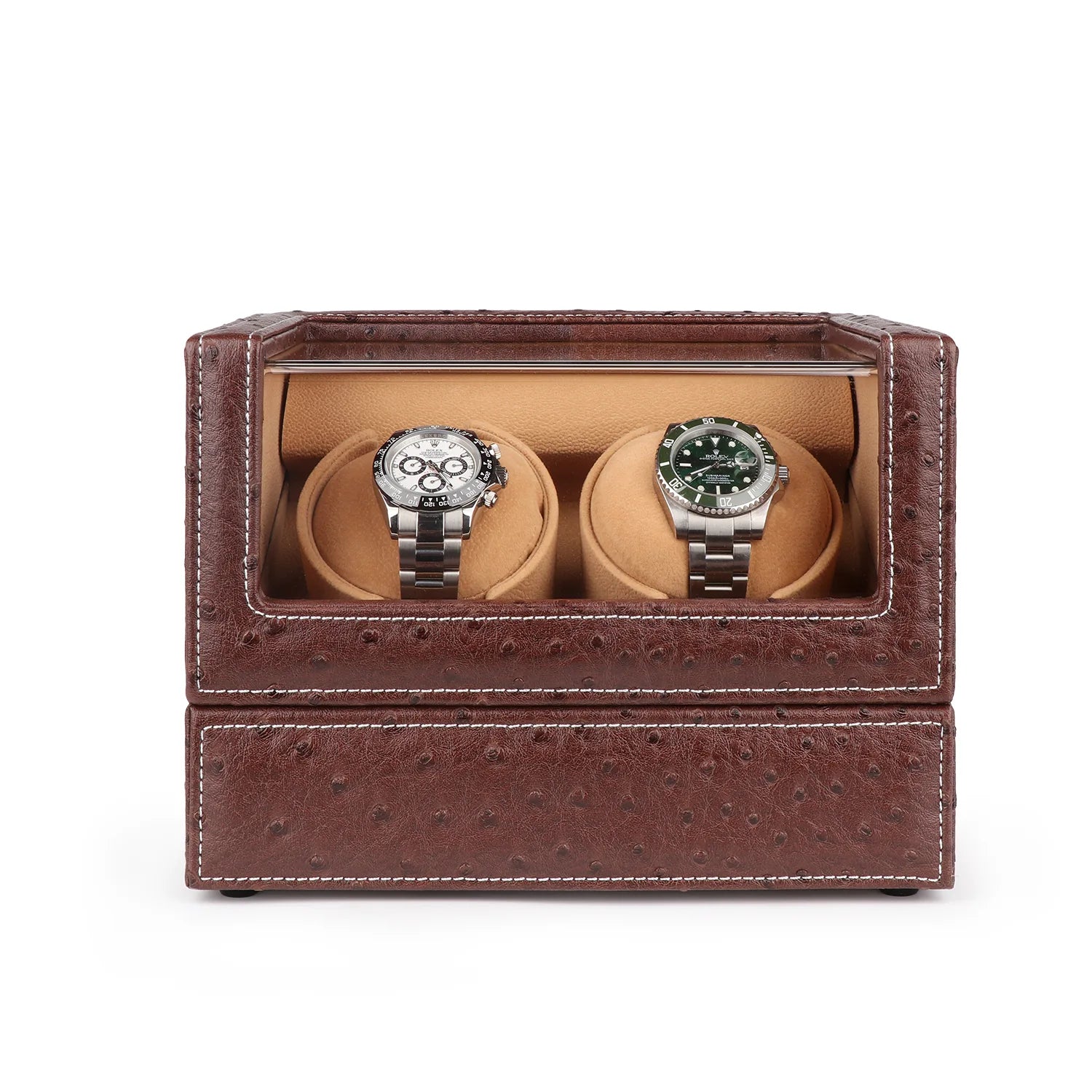
Ostrich leather is defined by its recognizable quill follicles—the dotted, raised pattern that gives it an instantly identifiable look. That texture reads as exotic and expensive even when rendered as a synthetic or embossed finish on a winder cabinet. For manufacturers, this is a high-impact design cue because it creates perceived value without requiring the full cost of genuine exotic leather.
It also aligns with what collectors already associate with higher-end watch accessories. Ostrich leather is described in watch-accessory references as both luxurious and surprisingly durable, with a soft, flexible feel that makes it practical as well as decorative. That combination is important in the winder market, where buyers want something that looks premium on a dresser but can also survive daily handling.
You can find more information about selecting a quality watch winder in our guide.
Consider a single watch winder options for optimal results.
Technical Specifications
Ostrich leather texture dominates the entry-level and lower-mid watch winder segment because it delivers a “luxury-look” finish at a relatively low production cost, while also hiding wear, fingerprints, and dust better than glossy lacquer or plain wood-grain finishes. In practical terms, brands can sell a visually premium product in the $50–$230 range without moving to genuinely expensive materials, while still offering the core features buyers expect: 4 winding modes, MDF construction, AC power, and watch-case clearance up to 60 mm on some models.
For your blog section, the most defensible technical angle is that ostrich texture is a surface treatment/finish rather than a structural upgrade. Driklux’s single winder uses a wood (MDF) frame, acrylic window, and 110–240V AC adapter, with support for watches up to 60 mm / 2.36 in including the crown. The triple version uses the same basic construction and also targets a 60 mm fit window, which matters for large sports watches like the Rolex Submariner, Datejust, and even the Daytona in many case configurations, especially when crown guards and bezel geometry make the watch feel larger on a cushion than the nominal case diameter suggests.
A technically accurate way to explain the appeal is to connect the winder to real watch compatibility needs. Many modern Rolex automatics use the Caliber 3135 or Caliber 3235, both of which are frequently paired with daily-wear models such as the Submariner and Datejust; buyers shopping for an inexpensive winder want a unit that can physically accommodate those watches, not just dress-watch dimensions. The same logic applies to chronographs like the Daytona, where the watch may be compact in diameter but can still require a properly sized pillow and safe clearance around the pushers and crown.
There are three reasons ostrich texture wins in this price tier:
- Visual premium: The quill-like pattern reads as exotic leather from a distance, so the product looks more expensive than an ordinary MDF box.
- Low manufacturing risk: It can be applied consistently to MDF housings, which keeps costs down and simplifies mass production.
- Buyer psychology: Entry-level buyers often want a display piece that looks appropriate next to a luxury watch, even if they are not paying for genuine exotic leather or Swiss motor modules.
You can find more information about watch winder buying guide in our guide.
A quality dual watch winder solutions makes a significant difference.
Expert Best Practices
Ostrich leather texture dominates the low-end watch winder sector because it delivers an expensive-looking, tactilely distinctive finish at a manufacturing cost that is far lower than genuine exotic leather. In practice, brands can give buyers a “luxury signal” on a MDF-based winder box without the cost, weight, or regulatory complexity of real exotic skin, which is why the finish appears so often on entry-level models like Driklux’s single and double winders.
For collectors, the appeal is straightforward: the ostrich pattern reads as premium at arm’s length, pairs well with steel sports watches and dress pieces, and photographs well in listings and ads. Driklux explicitly describes the finish as a “highly realistic ostrich leather texture” applied to an MDF body, which is exactly the low-end sector’s playbook: use a convincing decorative surface to elevate perceived value while keeping the enclosure affordable.
- High perceived value: The quill-follicle pattern creates visual depth that looks more exclusive than plain PU, vinyl, or faux carbon finishes.
- Cost control: The texture is typically an applied finish over MDF, not a full leather build, so manufacturers can keep prices in the entry range while still marketing a luxury aesthetic.
- Broad watch compatibility: A textured neutral finish complements common collector staples such as the Rolex Submariner, Datejust, and Daytona, which is useful in the $50–$230 buyer range where many owners want one box to work with multiple watches.
- Lifestyle positioning: Ostrich texture fits the same visual language as other “heritage luxury” materials used in watch accessories, including ostrich straps and exotic-style leather goods.
You can find more information about how to choose a watch winder in our guide.
A quality triple watch winders in ostrich leather texture makes a significant difference.
Common Challenges
Ostrich leather texture dominates the low-end watch winder sector because it delivers instant luxury signaling at low material cost, hides scuffs better than smooth finishes, and gives entry-level products a more expensive visual identity than plain PU, carbon-look vinyl, or glossy lacquer. In Driklux’s catalog, ostrich-texture winders are positioned as stylish, functional pieces with features like see-through windows, multiple winding modes, and case accommodation for larger watches, which is exactly what budget-conscious buyers want: premium aesthetics without paying premium-brand prices.
The key point is that ostrich texture is not used because it is the most technically complex finish; it is used because it is one of the most efficient visual upgrades in the sub-$230 category. Ostrich leather itself is associated with a distinctive quill pattern, durability, softness, and a subtle sheen, which makes it an easy shorthand for “luxury” even when the underlying box is MDF and the movement system is built to hit an accessible price point.
- High perceived value: The raised quill pattern reads as exotic and premium from a distance, so buyers often perceive the winder as more expensive than it is.
- Better resale-style presentation: On a dresser, ostrich texture looks more “watch-collector” than generic gloss black or faux wood, which matters for gift buyers and first-time collectors.
- Practical durability for daily handling: Ostrich leather is described as durable, resistant to cracking and wear, and surprisingly soft and flexible, which translates well to a product that gets opened, touched, and moved often.
- Compatibility with common luxury watches: Entry-level collectors usually own watches like the Rolex Submariner, Datejust, or Daytona, often powered by calibers such as the 3135 or 3235; the ostrich finish helps a budget winder look appropriate next to those watches even if the winder itself is inexpensive.
| Problem | Why it happens | How to solve it |
|---|---|---|
| Fake luxury effect | Buyers assume ostrich texture means real exotic leather, but many low-end winders use a simulated finish over MDF or synthetic wrap. | Read the material description carefully. If the listing says texture rather than genuine leather, assume it is a decorative finish and judge the product on motor quality, fit, and warranty rather than skin material. |
| Confusing looks with build quality | The finish can distract from weak hinges, noisy motors, or poor internal padding. | Prioritize the winding mechanism, case stability, and noise claims first; treat the texture as secondary. A good-looking box with a weak motor is still a poor winder. |
| Wrong capacity for the watch collection | Buyers often underestimate case size, especially for modern sports watches with thicker profiles. | Check case clearance before buying. Driklux’s triple winder is advertised to fit cases up to 60 mm, which is useful for larger pieces, but you should still measure your thickest watch, including crown guards. |
| Incorrect winding settings | Different calibers and brands need different turns-per-day and rotation direction. A one-size-fits-all setting can over-wind or under-wind certain pieces. | Use the winder’s mode options conservatively at first. For watches like a Rolex Datejust (caliber 3235) or older Submariner (caliber 3135), start with the gentlest effective setting recommended by the watchmaker or winder manual. |
| Noise in bedroom or office use | Lower-cost motors can be audible, especially in multiple-unit winders. | Place the winder on a stable surface, avoid hollow furniture, and check for customer feedback on motor sound before purchase. A quiet motor matters more than decorative texture for bedside use. |
| Finish wear and dust buildup | Textured surfaces collect dust in the dimples and can show uneven aging if neglected. | Clean gently with a soft brush or microfiber cloth. Avoid harsh solvents; use only products suitable for leather-look finishes or the specific material stated by the seller. |
| Mismatch with the watch’s style | Some collectors pair rugged dive watches with overly decorative cases or dress watches with flashy finishes that look inconsistent. | Match the winder to the watch family: a Submariner or Daytona can handle a more assertive texture, while a Datejust often suits a cleaner, restrained finish. If you own several styles, choose a neutral black or brown ostrich texture rather than bright colors. |
| Overpaying for decoration | Some listings bundle texture, window, and color options into a price that looks premium but adds little functional value. | Compare the price against the actual feature set. In the low-end segment, a fair range is often about $50–$230; if a model is priced above that, make sure you are paying for quieter motors, better controls, better padding, or a stronger warranty—not just the texture. |
- They buy the finish before the function. The texture is the easiest part to make look luxurious; the motor, gearing, and power stability are what determine long-term satisfaction.
- They assume “ostrich” means real ostrich leather. In budget winders, it often means ostrich-style embossing or a faux-exotic wrap rather than actual hide.
- They ignore watch size and weight. Larger watches, especially steel sports models like the Daytona or modern Submariner, need proper cushion fit and safe case clearance.
- They choose too many winding slots. If you only own one or two watches, a triple unit may look impressive but can waste space and budget; a single unit is often the smarter buy.
Many collectors benefit from understanding watch winder selection tips.
Consider a multi-watch winder systems for optimal results.
Buying Considerations
Ostrich leather texture dominates the low-end watch winder sector because it delivers a luxury look at a comparatively low manufacturing cost, photographs well for online retail, and gives budget winders a “premium” signal without the expense of full exotic leather or high-end wood finishing. In practice, many sub-$230 winders use ostrich-textured MDF or PU/vinyl wraps rather than genuine ostrich hide, which makes the finish a branding and merchandising tool more than a material specification.
The biggest reason it sells is simple: the quill-like dot pattern reads as exotic immediately, and ostrich leather itself is widely associated with distinctive texture, softness, flexibility, and durability in watch-accessory use. That combination is especially effective in the budget segment, where buyers want something that looks more expensive than a plain black leatherette box but still fits an affordable price band.
- Visual premiumization: The raised dot pattern breaks up flat surfaces and makes an inexpensive enclosure look more bespoke.
- Broad compatibility with dress and sports watches: Ostrich-style finishes pair well with Rolex models like the Submariner, Datejust, and Daytona, which are often sold as “collector” or “investment” watches that owners want displayed in a more luxurious setting. This matters for owners of automatic calibers such as the 3135 and 3235, which are commonly associated with Rolex sports and date watches.
- Low cost versus real exotic materials: A manufacturer can imitate the look of ostrich leather on MDF or synthetic wrap far more cheaply than using genuine exotic leather, keeping retail prices in the $50-$230 band typical of entry-level to lower-mid winders.
- Social-media friendliness: Texture reads well in product photos and short videos, which is important for direct-to-consumer brands selling online.
| Brand | Positioning | Typical price band | Ostrich texture use | What to know |
|---|---|---|---|---|
| Driklux | Value-oriented, design-led | Often under $230 | Uses ostrich leather texture on single and double winders | Good if you want the look without paying luxury-brand premiums. |
| Wolf | Established premium brand | Higher than most low-end import winders | More often uses structured leather, vegan leather, wood, or specialty finishes than obvious ostrich texture | Better engineering reputation, but you usually pay for the brand and mechanism rather than exotic-looking wrap. |
| Orbita | Functional, often technical | Mid to premium | Emphasis is typically on rotor systems and mechanical function, not ostentatious exotic texture | Strong for performance-first buyers; less about decorative finish. |
| Everest Bands | Strap specialist | N/A for winders | Relevant as a reference point for premium exotic-leather taste, not winders | Helpful benchmark for buyers who like refined texture on watch accessories. |
- $50-$100: Basic single winders, usually synthetic construction with decorative ostrich texture, limited control options, and minimal long-term serviceability.
- $100-$160: Better-finished single or double winders, more stable motors, better interior lining, and more credible presentation.
- $160-$230: The upper end of the “low-end” sector, where you may see quieter motors, better lighting, glass windows, stronger hinges, and more refined ostrich-style wrapping.
Many collectors benefit from understanding finding the perfect watch winder.
FAQs
What should I know about Why Ostrich Leather Texture Dominates the low-End-End Watch winder Sector?
Ostrich leather texture dominates the low-end watch winder sector because it delivers the visual language of luxury at a cost structure that is far easier to mass-produce than genuine exotic materials. For collectors, that matters because it explains why brands like Driklux, and retail channels such as WatchWinderUSA, can offer ostrich-textured winders as an accessible “premium look” alternative without crossing into true luxury pricing.
What are the most common mistakes to avoid?
Ostrich leather texture dominates the low-end watch winder sector because it delivers instant luxury signaling at low material cost, hides scuffs better than smooth finishes, and gives entry-level products a more expensive visual identity than plain PU, carbon-look vinyl, or glossy lacquer. In Driklux’s catalog, ostrich-texture winders are positioned as stylish, functional pieces with features like see-through windows, multiple winding modes, and case accommodation for larger watches, whic
What should I consider when buying?
| Brand | Positioning | Typical price band | Ostrich texture use | What to know |
|---|---|---|---|---|
| Driklux | Value-oriented, design-led | Often under $230 | Uses ostrich leather texture on single and double winders | Good if you want the look without paying luxury-brand premiums. |
| Wolf | Established premium brand | Higher than most low-end import winders | More often uses structured leather, vegan leather, wood, or specialty finishes than obvious ostrich texture | Better price |
Conclusion
Mastering why ostrich leather texture dominates the low-end-end watch winder sector ensures your luxury timepieces receive proper care. By investing in quality equipment and following best practices, you protect your investment for years to come.
Further Reading
For deeper understanding of the topics covered in this guide, explore these authoritative resources:
Product Gallery