

Watch Winders As Kinetic Art: Selecting Materials To Match Mid-Century Modern Homes

Table of Contents
- Overview and Key Concepts
- Technical Specifications
- Expert Best Practices
- Common Challenges
- Buying Considerations
- FAQs
- Conclusion
For serious collectors, a watch winder is not just a utility; it is a display object, a preservation tool, and part of the room’s visual architecture. In a mid-century modern home, the best examples behave like kinetic sculpture: restrained geometry, warm natural materials, and quiet mechanical precision.
You can find more information about choosing the right watch winder in our guide.

Overview and Key Concepts
For serious collectors, a watch winder is not just a utility; it is a display object, a preservation tool, and part of the room’s visual architecture. In a mid-century modern home, the best examples behave like kinetic sculpture: restrained geometry, warm natural materials, and quiet mechanical precision.
A good winder should match the watch, not just the décor. For Rolex owners, that usually means calibrating the winder to the movement’s behavior rather than choosing a one-size-fits-all setting. The Rolex Submariner and Datejust are most commonly associated with the Caliber 3135 in earlier references and the Caliber 3235 in newer generations, while the Daytona uses different chronograph calibers depending on reference, so correct rotation settings matter more than brand prestige alone. If the winder over-winds, or rotates too aggressively, it adds wear without benefit.
Collectors should also think in terms of use-case:
- Daily-wear watch on a modern Rolex caliber: prioritize low noise, programmable turns per day, and bidirectional settings.
- Vintage or less frequently worn watch: choose a gentler cycle and avoid unnecessary continuous running.
- Small collection: a single winder is often better than a multi-unit cabinet if the goal is elegance in a living room or study.
- Larger collection: a cabinet-style piece can function as furniture, but only if the materials and proportions suit the space.
Mid-century modern design is built on honest materials, clean lines, and functional beauty. That makes the watch winder an unusually good fit when it avoids “gadget” aesthetics. The best visual pairings typically use:
- Walnut, teak, or oak tones
- Brushed metal accents
- Leather or vegan-leather wraps in cognac, black, or saddle brown
- Low-profile rectangular or cylindrical forms
- Matte finishes rather than glossy, piano-black surfaces
A winder with a heavy glass box or flashy LED treatment can look out of place in a room anchored by Eames-era furniture, tapered legs, and low-slung case goods. By contrast, a wood-clad or leather-trimmed unit can feel like it belongs beside a credenza, record cabinet, or bar cart.
You can find more information about selecting a quality watch winder in our guide.
Professional collectors often choose single watch winder options.
Technical Specifications
For a Mid-Century Modern interior, the best watch winders read like small pieces of furniture: warm wood veneer, brushed metal, glass, and compact proportions that echo low-slung cabinetry and sculptural lighting. In practice, brands like Wolf and Driklux cover the premium end, while more accessible options typically sit in the $85–$300 range for single- or double-watch boxes; the design trade-off is usually between aesthetics, motor quality, and programmability.
-
Walnut, Macassar ebony, and rosewood finishes work best when the room already has teak, walnut, or cane details; Orbita’s Avanti 48 Macassar – Rotorwind is a strong example of a high-end, furniture-grade presentation at $49,995.
-
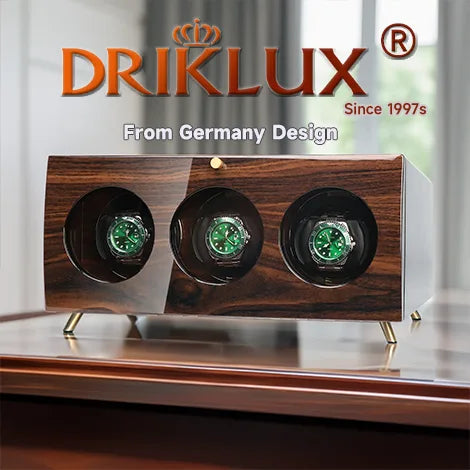
Stepper Brushless motor and solid wood suit homes with Saarinen-style tables, walnut consoles, and sculptural lamps because they visually “float” instead of looking ornate; Driklux’s S-series and wood-style lines lean into that cleaner, architectural look.
-
Glass lids make the mechanism feel like kinetic sculpture, especially when displayed on open shelving or a credenza rather than hidden in a closet at Driklux T-series product.
-
Vegan leather or matte lacquer is better for a quieter, more restrained look than glossy piano black, especially in rooms with a lot of natural light.
-
Wolf 1834 is the easiest premium recommendation for collectors who want a refined, everyday-use winder; current examples include the Roadster Single Watch Winder at $839, Classic Single at $390, Classic Double with Storage at $1,775, Classic Triple with Storage at $2,689, and Roadster 6 Piece at $4,405.
-
Orbita is the “kinetic art” brand in this category, with large modular pieces like the Avanti Three Rotorwind W70000 at €2,799, Six Rotorwind W70001 at €5,199, Nine Rotorwind W70007 at €7,999, Twelve Rotorwind W22041 at €11,899, Twenty Four Rotorwind W70003/W70004 at €26,999, and Thirty Six Rotorwind W70005 at €36,999.
-
For smaller, functional statement pieces, Orbita also lists a Tourbillon 3-Unit Watch Winder around $2,545.75, which is a strong choice if you want visible motion without the footprint of a large cabinet.
-
The most commonly discussed Rolex automatic calibers for modern winding guidance are Caliber 3135 and Caliber 3235, which appear in watches such as the Submariner, Datejust, and some Sea-Dweller references; the Daytona is the key exception because most modern Daytonas are not automatic-wind in the same way as the Datejust/Submariner family.
-
For a practical collector’s setup, a Submariner with Caliber 3135 or 3235 and a Datejust with Caliber 3235 are ideal candidates for a quality programmable winder, especially if the watch rotates in and out of daily wear.
-
If the watch is a modern Daytona, confirm the movement before buying a winder; only automatic models should be considered for winding storage, and the decision should be based on the specific reference rather than the model name alone.
-
Wolf’s and Driklux's compact single-winder proportions are suitable for a desk or dresser: one listed Single Watch Winder measures 5.4 x 8.9 x 6.8 in, while the Single Watch Winder/Storage measures 7.8 x 7.3 x 8.8 in.
-
Orbita’s smaller shop-listed units include examples around 6 x 4 x 4 in and 13.5 x 15 x 8.5 in depending on configuration, which is helpful when fitting the winder into a narrow shelf or sideboard vignette.
You can find more information about watch winder buying guide in our guide.
Consider a dual watch winder solutions for optimal results.
Expert Best Practices
For a mid-century modern home, the best watch winders read like furniture, not gadgets: choose walnut, teak, smoked acrylic, matte lacquer, brass accents, or carbon fiber only when used sparingly and with clean geometry. For Rolex owners, target a setting around 650 TPD in bidirectional mode for modern automatic calibers such as 3235/3230, while older 3135-powered watches may be happier with slightly broader tolerance because the movement has a shorter stated reserve and different winding behavior.
Mid-century modern design rewards restraint, warm wood tones, and low-profile silhouettes. In practice, that means:
- Best matches: walnut, teak, rosewood veneer, smoked acrylic, black lacquer, brushed aluminum, and brass trim.
- Avoid overdoing: high-gloss piano black, oversized chrome frames, loud carbon-fiber weave, and faux “luxury” textures that fight the furniture rather than complement it.
- Use contrast deliberately: a smoked acrylic case can make a winder disappear on a walnut credenza, while a walnut-veneered unit can echo a Danish sideboard and feel architectural rather than decorative.
If you want a winder that feels like an object of design, Driklux is one of the strongest references for sculptural presentation, with models ranging from entry-level TPD single pieces around $85 to large 15 watches configurations from roughly $80 to $19,998 depending on capacity and execution. Their T-series and D-Series lines in temperglass window, carbon fiber, and wood-finished options are especially relevant to a curated interior.
Wolf sits in the more accessible luxury segment and offers cleaner, more domestic-friendly designs; current market examples include pieces around $605 for the 4.1 Expandable Winder and about $969 for the Cortica II single winder. For collectors who want a premium but not museum-grade statement piece, Wolf is often the sweet spot for a primary bedroom or study.
Many collectors benefit from understanding how to choose a watch winder.
Professional collectors often choose compact classic triple watch winders.
Common Challenges
When used well, a watch winder can function as kinetic art in a Mid-Century Modern home; when used poorly, it becomes a noisy, magnetic, mismatched appliance. The main problems are usually fit, settings, materials, noise, and power reliability—and each has a practical fix.
| Problem | Why it happens | How to solve it |
|---|---|---|
| Wrong TPD or direction | Automatic movements vary widely in winding needs, so generic settings can leave a watch underwound or overworked. | Match the winder to the watch’s required Turns Per Day (TPD) and rotation direction; verify in the watchmaker’s documentation or a trusted movement guide before choosing a program. |
| Watch still stops in the winder | The most common causes are incorrect settings, poor power supply, or an aging movement that no longer winds efficiently. | Check power first, then confirm TPD/direction, then consider a service if the movement itself is tired. |
| Overwinding concerns | Continuous winding can unnecessarily stress the slipping clutch and winding components, especially on low-quality units or if the watch is left spinning after it is already fully wound. | Use a winder with programmable rest cycles and avoid “more is better” settings; a premium unit should stop or pause intelligently rather than run continuously. |
| Magnetism | Cheap motors and poor shielding can create external magnetic fields that magnetize the movement. | Choose a winder known for low magnetic leakage, and keep it away from speakers, power bricks, and other magnetic sources. |
| Noise and vibration | Low-grade motors, loose components, or resonant placement can create grinding, buzzing, or audible vibration. | Put the winder on a solid, level surface; prefer brushless or quiet-drive motors; and avoid hollow shelves that amplify vibration. |
| Watch slipping or falling | Cushions that are too loose or too hard fail to secure different case sizes and strap types. | Measure your case diameter and strap length before buying; choose adjustable holders with soft, stable cradle materials. |
| Overheating | Poor ventilation, stalled motors, or long continuous operation can raise internal temperatures. | Leave airflow around the unit, avoid direct sun, and pick models with thermal protection or conservative duty cycles. |
| Power failures or intermittent operation | Loose cords, dead batteries, weak adapters, or unstable power interrupt rotation. | Use a reliable adapter, check contacts regularly, and avoid bargain units with no documented power regulation. |
| Poor long-term durability | Cheap winders may use weak motors, inferior plastics, or poor bearings that fail early. | Buy from established brands with better engineering and warranty support rather than no-name units with vague specs. |
For a Mid-Century Modern home, the winder should read like a sculptural object, not a gadget. That means favoring walnut veneer, teak tones, brushed aluminum, matte black metal, leather, and warm glass over glossy piano-black plastic and chrome-heavy styling.
-
Walnut or teak veneer: Best for homes with Eames, Knoll, or Danish-modern influences because it echoes the period’s furniture language.
-
Brushed aluminum: Works well when the room already uses stainless accents, architectural lighting, or more industrial MCM details.
-
Leather or suede interiors: Adds a luxury cue and protects bracelet finishes; it also visually softens the interior.
-
Matte lacquer or satin finishes: Better than high gloss in MCM rooms because they feel more architectural and less “tech accessory.”
-
Glass display lids: Useful if you want the winder to behave like a small kinetic vitrine, but only if the motors are quiet and the interior lighting is restrained.
-
High-gloss black plastic
-
Fake carbon fiber
-
Overly bright blue LEDs
-
Cheap chrome trim
-
Foam holders that compress unevenly and age poorly
For detailed guidance, see our article on watch winder selection tips.
Professional collectors often choose maintaining your automatic watch.
Buying Considerations
For a mid-century modern home, the best watch winders are the ones that read like furniture first and accessory second: walnut, teak, burl, lacquer, leather, glass, and restrained metal accents work far better than glossy “tech” aesthetics. In practice, Wolf is the easiest premium buy for a clean modern look, Orbita is the most interesting if you want engineering-forward styling and collector-grade variety, while value-focused alternatives in the broader market tend to cluster around the $50–$230 range for basic units and jump into the $500+ range once you want quieter motors, better finishes, and programmable settings.
Mid-century modern design favors warm woods, low visual noise, geometric lines, and honest materials. That means a winder should complement teak credenzas, walnut sideboards, brass accents, and smoked glass rather than fight them.
Look for:
- Walnut, teak, burl wood, or matte ebony finishes rather than high-gloss piano black.
- Leather, suede, or cork-lined interiors for a softer, warmer presentation.
- Brushed steel or brass hardware instead of bright chrome.
- Compact, architectural shapes with clean edges and minimal branding.
- Quiet motors, because MCM homes often place the winder in a bedroom, study, or open-plan living area.
Wolf is the most straightforward recommendation if you want polished luxury with a modern-retro fit. The brand is known for using leather, wood, glass, and steel in designs that look at home on a walnut dresser or in a built-in bar cabinet. Premium Wolf models can easily land in the $600 to $2,095 range depending on capacity and storage features, which puts them in the serious collector tier rather than the entry level.
Best for:
- Buyers who want a recognizable luxury brand.
- Homes where the winder is part of the décor.
- Multi-watch owners who want storage plus winding in one object.
You can find more information about finding the perfect watch winder in our guide.
FAQs
What should I know about Watch Winders as Kinetic Art?
- Driklux and Wolf are often the most visible luxury option, with broad pricing from roughly the low hundreds to several thousand dollars depending on capacity and finish.
- Orbita is respected by collectors for its technical approach geek.
What are the most common mistakes to avoid?
| Problem | Why it happens | How to solve it |
|---|---|---|
| Wrong TPD or direction | Automatic movements vary widely in winding needs, so generic settings can leave a watch underwound or overworked. | Match the winder to the watch’s required Turns Per Day (TPD) and rotation direction; verify in the watchmaker’s documentation or a trusted movement guide before choosing a program. |
| Watch still stops in the winder | The most common causes are incorrect settings, poor power supply, |
What should I consider when buying?
Mid-century modern design favors warm woods, low visual noise, geometric lines, and honest materials. That means a winder should complement teak credenzas, walnut sideboards, brass accents, and smoked glass rather than fight them.
Conclusion
Mastering watch winders as kinetic art: selecting materials to match mid-century modern homes ensures your luxury timepieces receive proper care. By investing in quality equipment and following best practices, you protect your investment for years to come.
Further Reading
For deeper understanding of the topics covered in this guide, explore these authoritative resources:
Product Gallery